
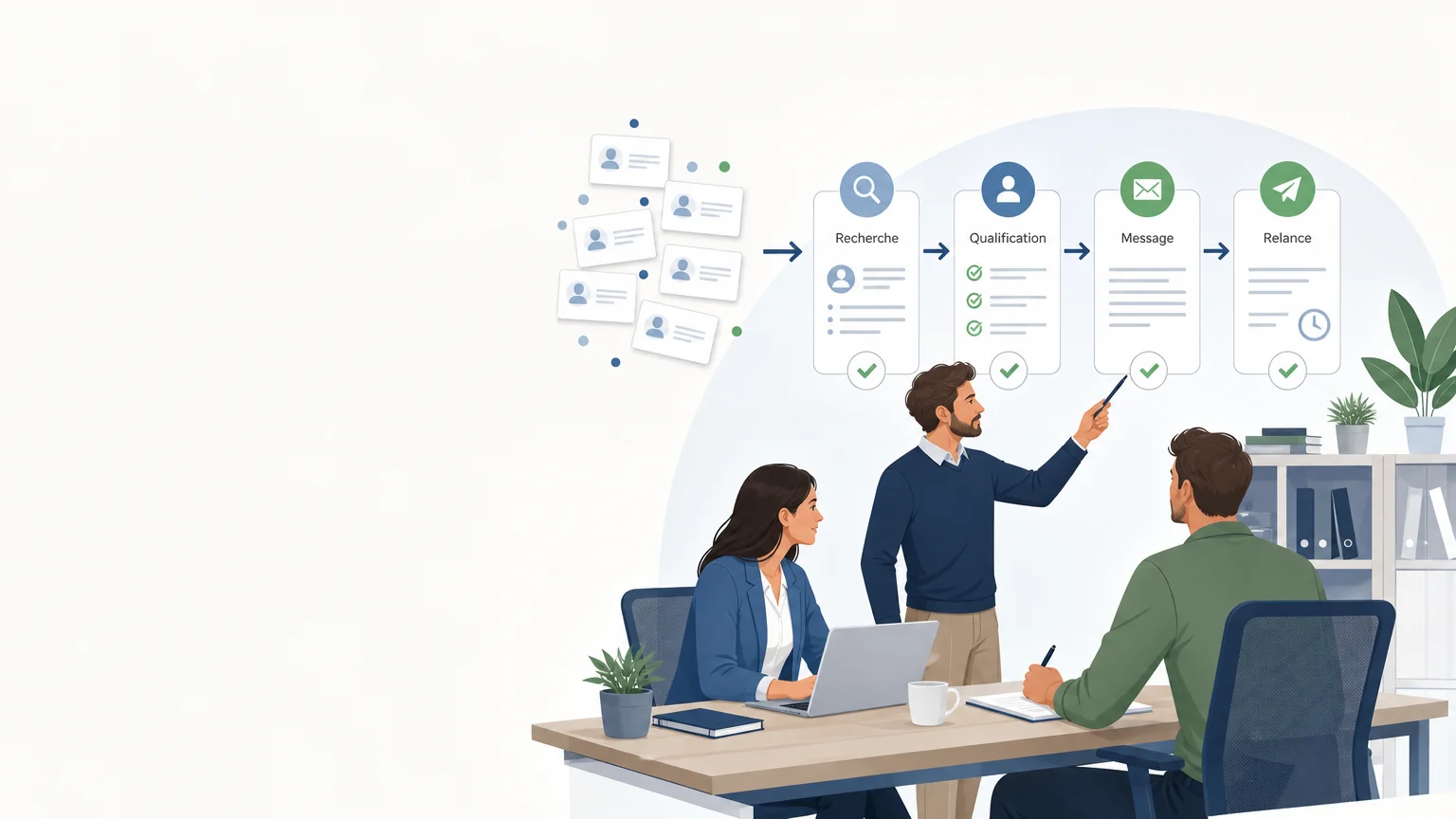
Do you have to choose between higher volume and a truly personalized approach? The answer is no, provided you automate the right steps. To save time from the very beginning of prospect research, our AI agent for prospecting can prepare future actions while leaving sales reps in control of conversations and important decisions.
Automated prospecting addresses a very real problem: teams still spend a lot of time searching for contacts, verifying details, drafting messages, and scheduling follow-ups. In 2025, Insee reported that 18% of French companies with 10 or more employees used at least one artificial intelligence technology, compared to 10% in 2024. This increase doesn't mean all processes are automated, but it confirms that AI tools are progressively entering sales operations.
What is automated prospecting?
Imagine a sales team that needs to identify 200 prospects, find their contact information, understand their business, prepare an approach, and follow up with those who don't respond. Without tools, each step is done separately. With an automated approach, part of this work can be executed or prepared by software based on predefined rules.
Automated prospecting therefore refers to the use of software, data, and scenarios to organize the repetitive actions of business development. It can cover prospect research, qualification, contact information enrichment, message drafting, sending certain sequences, scheduling follow-ups, and tracking responses.
It should not be confused with mass message sending. A tool that contacts many people without verifying their relevance merely accelerates a bad method. Quality depends primarily on the ideal customer profile, data reliability, and the context available to personalize each approach.
The topic became particularly concrete in 2026. According to a publication by the Banque de France, more than two-thirds of companies with at least 20 employees surveyed in early 2026 reported using generative AI tools. However, the study highlights that the observed gains are still primarily related to productivity. In other words, the challenge is no longer just about adopting a technology, but integrating it into a coherent sales process.
What tasks can be automated in prospecting?
Let's take a classic B2B campaign. A sales rep doesn't create value in the same way when searching for an email address, reading an interested reply, or negotiating a proposal. Automation is relevant when the task is repetitive, structured, and controllable. It should remain limited when the human context becomes crucial.
Prospect research and targeting
A tool can help identify companies matching several criteria: sector, size, location, desired role, or activity signals. This step helps build more homogeneous lists and avoids treating all contacts as if they had the same needs.
However, targeting should not be entirely delegated to a database. The sales team must verify that the criteria genuinely correspond to market reality. A job title might be incorrect, a company's strategy might have changed, or a decision-maker might no longer be involved in the relevant topic.
Enrichment and qualification
Enrichment involves completing a profile with useful information: professional email address, phone number, role, company size, or contextual elements. Qualification adds an extra question: does this prospect truly fit the target, and is there a credible reason to contact them now?
This distinction is important. Complete data is not necessarily relevant data. A valid phone number is not enough if the person is not concerned by the offer. A verified email address does not guarantee that a commercial message will be expected or useful.
Message and follow-up preparation
Tools can suggest an opening based on the sector, job title, and available company information. They can also schedule a follow-up when a conversation remains unanswered. The value then comes from the ability to adapt the content, not just from repetition.
A good sequence should include stop conditions. If the prospect replies, the automatic sequence must stop or change status. If they ask not to be contacted again, they must be removed from the relevant campaigns. If they show interest, the priority becomes a human response, not sending the next automated message.
Tracking and centralization
Automated tracking helps maintain interaction history, spot forgotten follow-ups, and identify prospects who have responded. It becomes particularly useful when multiple sales reps work on the same target. Without shared context, a person might receive multiple contradictory messages or be followed up with while a conversation is already underway.
A solution like our sales prospecting software addresses this issue by grouping research, enrichment, action preparation, and tracking in a single workspace. The goal isn't to eliminate the sales rep's role, but to reduce the need for juggling multiple tools.
Why shouldn't automation replace the sales rep?
Imagine a prospect responds: "Your topic interests me, but we've just changed suppliers. Contact me again in six months." A standardized follow-up is no longer sufficient. You need to understand the context, record the correct information, and choose an appropriate response for that commercial moment.
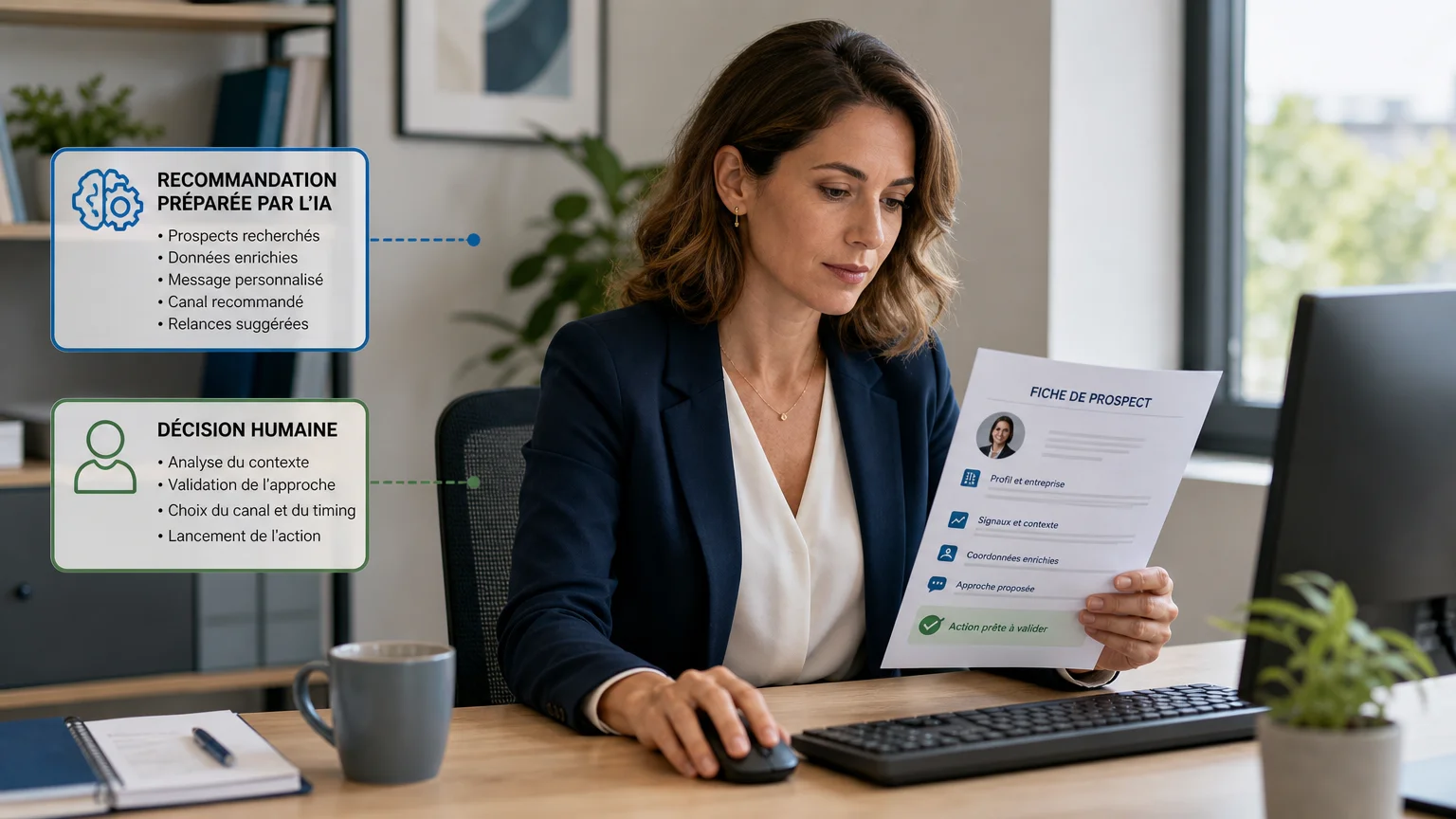
Automated prospecting therefore works best when it clearly separates two categories of actions. Repetitive tasks can be prepared or executed automatically. Exchanges requiring listening, interpretation, negotiation, or decision-making must remain under human control.
- To automate: initial research, criteria detection, enrichment, message preparation, reminders, and status updates.
- To validate: final targeting, message tone, relevance of the hook, and channel selection.
- To handle humanly: positive replies, objections, requests for clarification, sensitive exchanges, and commercial closing.
This organization avoids two common mistakes. The first is doing everything manually, which slows down prospecting and leads to oversights. The second is automating without control, which produces out-of-context messages and can damage a company's reputation.
How to build an effective automated prospecting method?
A simple example illustrates the logic. A consulting agency wants to contact sales managers in industrial SMEs. They don't start by choosing software. They start by defining the target companies, the problem addressed, and the signal that justifies making contact.
- Define the target: specify the sector, company size, target roles, geographic area, and exclusions.
- Formulate the reason to talk: identify the problem your offer solves and the context in which this problem becomes a priority.
- Prepare the data: verify contact details, remove duplicates, and distinguish certain information from assumptions.
- Choose channels: select email, LinkedIn, or phone based on your target's habits and the nature of the message.
- Create a short sequence: plan a first contact, a useful follow-up, and a clear stop rule.
- Define human handover: indicate who responds, within what timeframe, and with what information when the prospect shows interest.
- Measure and adjust: analyze responses by segment, channel, and message angle before increasing volume.
Personalization doesn't mean automatically inserting a first name. It means linking the message to an identifiable situation. A sentence that mentions a company's evolution, a specific role, or a sector-specific challenge can be more relevant than a long text full of variables.
It's also important to plan for multiple levels of personalization. A broad segment might receive an approach tailored to its industry. A strategic account deserves deeper research and a message entirely reviewed by a sales rep. Automation then serves to reserve human time for contacts that truly warrant this effort.
What criteria should you use to choose a tool?
The right tool isn't the one with the most features. It's the one that covers the important steps of your process without creating a new series of manual operations. Before comparing solutions, describe the complete prospect journey, from research to the meeting.
- Targeting quality: Do the search criteria match your ideal customer profile?
- Data reliability: Are contact details verified, and can information be corrected?
- Personalization: Does the tool use real context or just generic fields?
- Available channels: Can you coordinate email, LinkedIn, and phone when relevant?
- Response management: Does the tool stop follow-ups when the prospect responds or objects?
- Human control: Can actions be reviewed and validated before execution?
- Shared history: Does the team maintain context, exchanges, and learnings?
- Measurement: Are results clear by segment, campaign, and channel?
- Budget: Does the billing truly match the volume of actions you need?
For a team looking to avoid piecing together multiple software, our approach brings together sourcing, enrichment, message preparation, and follow-ups into a single logic. Actions prepared by AI are presented individually for validation before execution. LinkedIn, email, and phone channels can also be monitored in the same inbox, with a common history.
The billing model is another practical criterion. With GetCalls, credits are consumed per action: 1 credit for a LinkedIn profile, 3 credits for an email profile with an enriched and verified address, and 9 credits for a phone profile with an enriched number. No credits are charged if enrichment fails. The monthly volume can be adjusted or stopped without commitment.
To delve deeper into selection criteria, our article on the best sales prospecting software allows for a more precise comparison of approaches based on team size, channels, and desired level of centralization.
How to remain compliant and measure results?
An automated campaign must be designed with the same requirements as a manual campaign. You need to know the origin of the data, inform the people concerned, respect opt-out requests, and limit solicitations to situations where they are relevant.
In France, rules vary depending on the audience and channel. The CNIL reminds that electronic prospecting to individuals generally requires prior consent. For professionals, individuals must be informed and able to object to the use of their contact details for prospecting purposes. These obligations notably concern emails, SMS, and automated calls.
Compliance is not limited to adding an unsubscribe phrase. You must also document the purposes, limit collected data, control its retention period, and avoid files of uncertain origin. For LinkedIn, volumes must remain controlled, and the platform's terms of use must be consulted before implementing automation.
Measurement should focus on the quality of the process, not just the number of messages sent. At a minimum, track the response rate, the proportion of qualified responses, the number of appointments obtained, the handling time, and the opt-out rate. Analyze these indicators by segment, as a campaign might work for one target and fail for another.
Initial results should be used to correct targeting and messaging. A drop in responses can come from a poor hook, outdated data, a poorly chosen channel, or too frequent follow-ups. Automation provides signals, but it's the team that must interpret these signals and decide on changes.
Small businesses can start gradually. In 2026, France Num presented several use cases where AI helps VSEs and SMEs analyze data, automate certain tasks, and enrich a B2B prospecting file. The important thing is to choose a measurable use case, verify the data, and maintain human validation for commercial actions.
Key takeaways
Automated prospecting is primarily an organizational method. It helps reduce the time spent on research, preparation, and follow-ups, but it doesn't transform imprecise targeting into an effective strategy. To achieve meaningful conversations, start with a clear ideal customer profile, clean data, contextualized personalization, and explicit stop rules. Automation should prepare the sales groundwork, while humans maintain the relationship, listen, qualify, and close.
Automate Prospecting Without Losing Control
If your team still spends too much time researching prospects, preparing messages, and tracking follow-ups, an integrated approach can simplify daily operations. The goal is to have tools working in the background while leaving important decisions to sales representatives.
With GetCalls, you can connect LinkedIn or your email inbox, provide your website URL or offer description, and then validate the initial actions prepared. The free trial is accessible without a credit card, with 500 credits unlocked after account setup and validation of a first campaign. Test prospecting automation at your own pace, with adjustable volume and no-commitment cancellation.
Frequently Asked Questions
Does automated prospecting replace sales reps?
No. It handles certain repetitive tasks, but sales reps remain essential for understanding needs, addressing objections, qualifying opportunities, and closing deals.
What channels can be automated?
The main channels are email and certain actions on LinkedIn, with potential follow-up by phone depending on the tools and process chosen. The channel should be selected based on the target's habits and the message's context.
How can impersonal messages be avoided?
You need to segment the target audience, use information genuinely related to the prospect, and limit generic variables. Effective automation prepares a contextualized message, then plans for human intervention once the conversation begins.
How much does an automated prospecting solution cost?
The cost depends on the volume, channels, and desired level of enrichment. At GetCalls, pricing is credit-based, with €80 ex. VAT for 1,000 credits, and different consumption depending on the action performed.
Can I test GetCalls before committing?
Yes. The free trial is offered without a credit card, with 500 credits unlocked once the account is configured with LinkedIn or email connected and a first campaign is validated.