
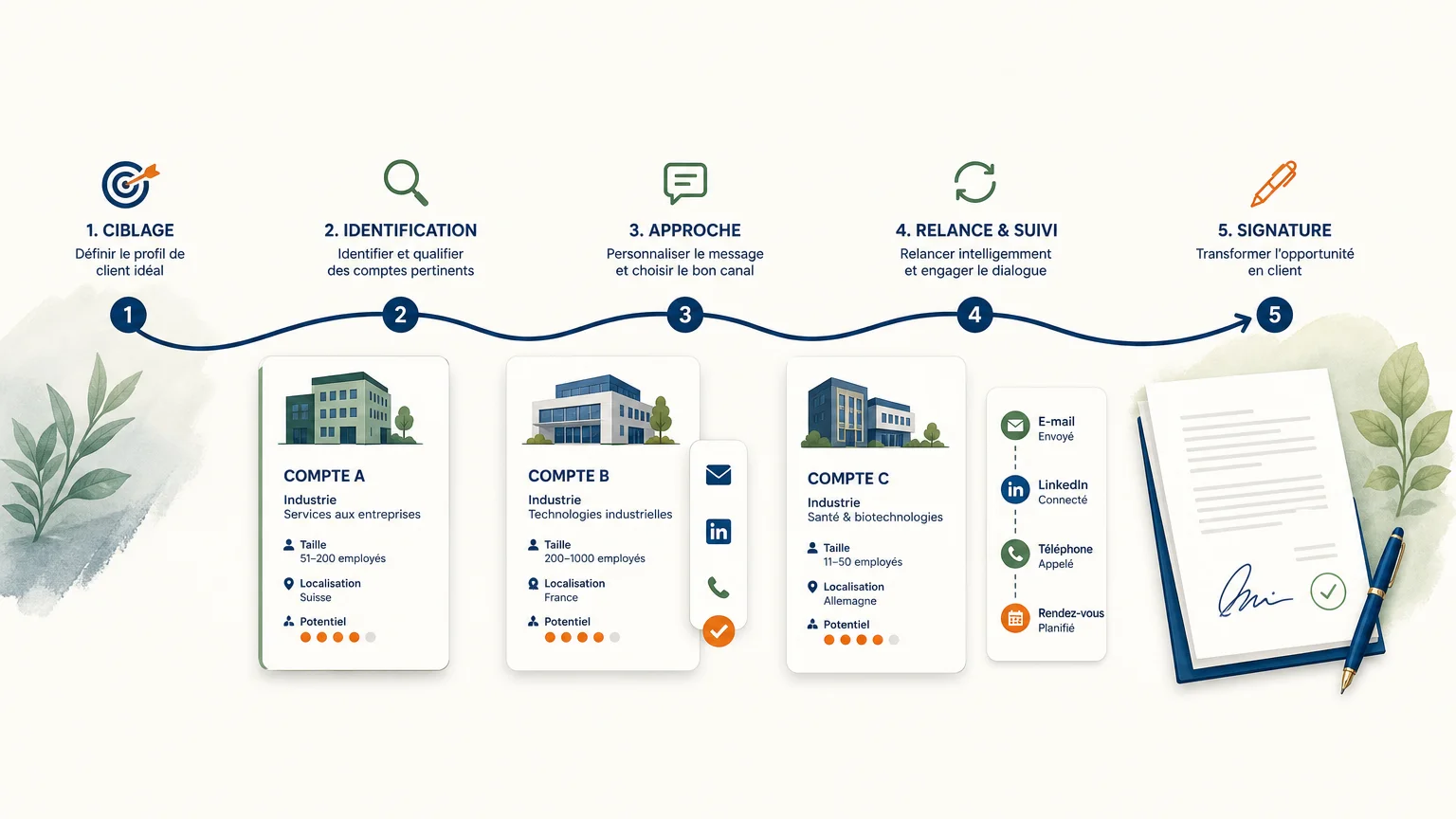
Why do some companies consistently generate qualified appointments, while others multiply contacts without increasing their revenue? The difference rarely comes down to volume alone. It's based on the quality of targeting, understanding needs, and the ability to methodically advance each opportunity. To structure your prospecting, you can also consult our guide to the best sales prospecting software.
B2B sales involve businesses, multiple decision-makers, and purchases often linked to operational stakes. The salesperson must therefore sell a solution, but also reduce perceived risk, build trust, and facilitate internal decision-making. This logic applies to software, professional services, equipment, raw materials, and recurring offerings.
What do B2B sales truly encompass?
A B2B sale corresponds to the commercialization of a product or service by one company to another organization. The buyer can be an SME, a mid-sized company, a large group, an administration, or a network of professionals.
The purpose of the purchase is professional. Businesses generally seek to save time, reduce costs, secure an operation, increase productivity, or develop their own revenue.
B2B is therefore not limited to large contracts. An agency selling a service to an SME, a manufacturer supplying a part to an industrial client, or a publisher marketing subscription software all engage in B2B sales.
The value of a sale depends on the sector, the level of personalization, and the complexity of the need. A simple order can be concluded quickly. A strategic solution may require several months, multiple meetings, and the agreement of several departments.
In this context, the value proposition must go beyond simply presenting features. It must explain the problem addressed, the expected results, the implementation conditions, and the controlled risks.
B2B vs. B2C: What are the commercial differences?
Imagine a person buying an online subscription. They compare a few options, check reviews, then pay alone. The journey can be short and largely automated.
In a B2B sale, the same purchase can involve a user, a business manager, an IT department, a buyer, and a financial director. Each examines the solution with their own criteria.
| Criterion | B2B Sales | B2C Sales |
|---|---|---|
| Buyer | Company or organization | Individual |
| Decision | Often collective and documented | Often individual or family |
| Cycle | Structured, sometimes long | Often fast |
| Motivation | Performance, risk, return on investment | Usage, price, comfort, or emotion |
| Relationship | Follow-up, renewal, and account development | Transaction, loyalty, and repeat purchase |
This distinction does not mean that B2B purchases are entirely rational. Trust, reputation, and the quality of the relationship also influence the decision. However, emotion often relates to professional responsibility, the risk of error, and the ability to defend the choice internally.
The consequence is direct: the salesperson must map out the stakeholders. They adapt their discourse according to each person's priorities, while maintaining a coherent overall promise.
The stages of a structured B2B sales process
An effective sales cycle resembles a series of verifiable decisions. Each stage must have an objective, a deliverable, and a passing criterion.
- Define the Target: Identify the industries, company sizes, roles, and situations where your offering creates clear value.
- Prospect: Research relevant accounts and engage contacts with a message tailored to their context.
- Qualify: Verify the need, budget, timeline, authority, and decision-making criteria.
- Discover: Analyze the prospect's problems, consequences, objectives, and selection criteria.
- Present: Connect your solution to their expressed challenges and demonstrate the expected benefits.
- Handle Objections: Clarify concerns related to price, risk, timeline, integration, or change.
- Negotiate and Close: Formalize the scope, terms, responsibilities, and next steps.
- Monitor and Develop: Support the client, measure satisfaction, and identify renewal opportunities.
Prospecting should not be isolated from the rest of the cycle. A poorly targeted contact leads to poor qualification. Insufficient discovery results in a generic proposal. Follow-up without context slows down the decision.
In 2026, prospecting remains a very time-consuming activity. According to HubSpot's sales report, 49% of professionals surveyed still spend at least two hours a day on this task.
This data doesn't mean that every interaction needs to be automated. Rather, it highlights the importance of reserving human time for exchanges that require discernment, active listening, and genuine advisory skills.
Prospecting Without Confusing Volume with Relevance
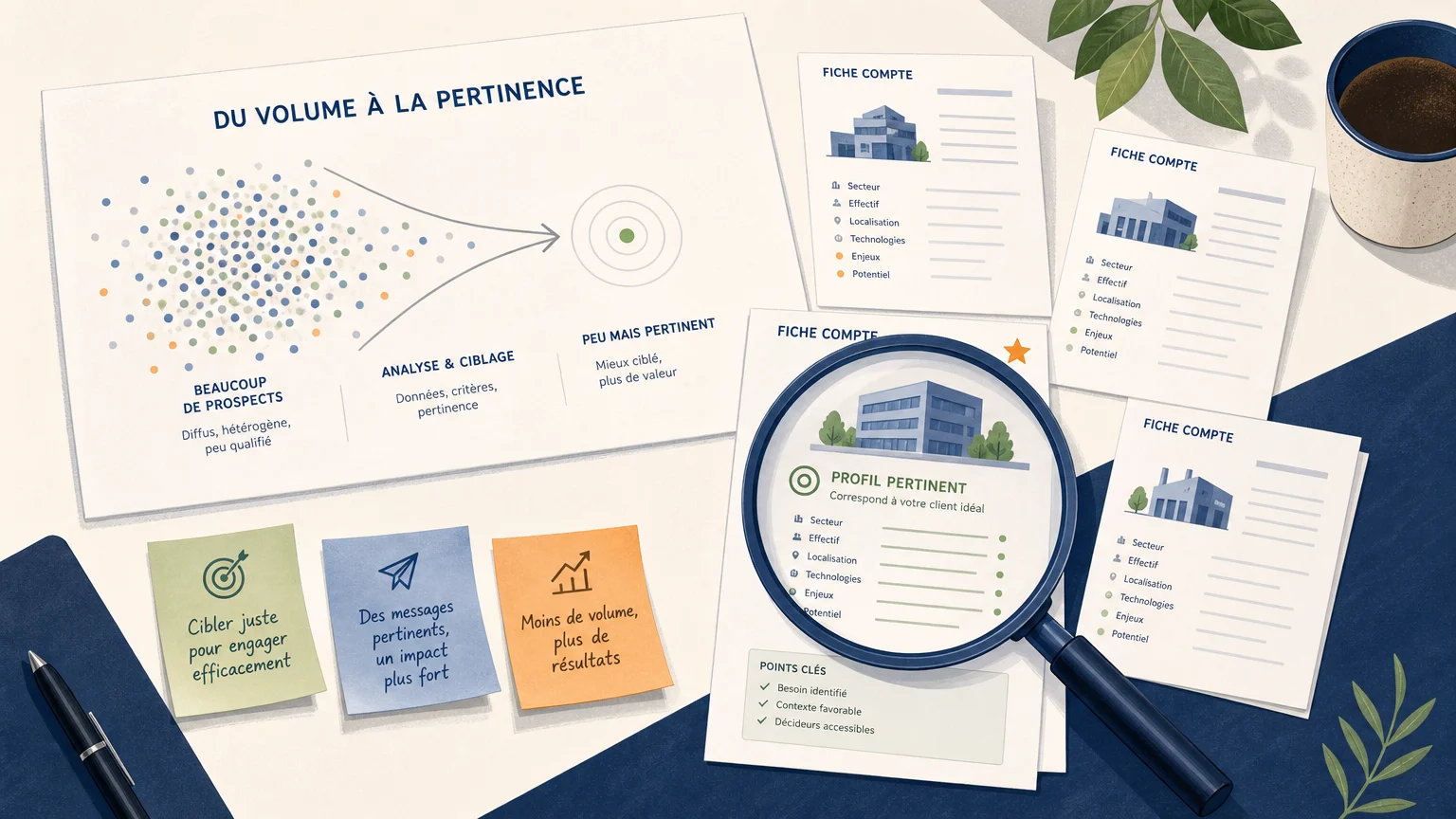
A database of several thousand contacts does not automatically constitute a sales pipeline. The quality of a list depends on its alignment with your ideal customer profile, the reliability of the contact information, and the timing chosen to contact the company.
Start by defining the characteristics of accounts that are most successful with your offering. Examine their industry, size, organization, tools, priorities, and the events that often precede a purchase.
Then, add the relevant contacts. The economic decision-maker isn't always the end-user. A sales manager might express the need, while the finance department or procurement validates the commitment.
Multichannel prospecting can combine email, phone, LinkedIn, referrals, events, and expert content. The right channel depends on the industry, the targeted role, and the prospect's maturity.
Each point of contact should provide a credible reason to engage. An observation about the company's activity, a regulatory change, or an industry challenge is better than a generic message.
Follow-up must also account for silence. A prospect who doesn't respond immediately isn't necessarily lost. They might be short on time, awaiting a budget, shifting priorities, or not be the right contact.
We can help you reduce this operational burden with a workflow that finds prospects, enriches contact details, prepares outreach, and centralizes exchanges. However, the team retains the ability to validate actions before they are executed.
Qualify Opportunities Before Investing Time
An opportunity deserves to move forward when it meets several favorable conditions. The prospect must have a real problem, recognize its importance, and have a credible path towards a decision.
The BANT method can serve as a starting point with four questions: Does a budget exist? Does the contact have sufficient authority? Is the need established? Is the timeline defined?
This framework should remain flexible. A prospect might not have a formalized budget but could have an urgent problem and an internal sponsor capable of moving the project forward.
Qualification should therefore assess the situation rather than mechanically checking boxes. Specifically, seek to understand:
- the concrete consequences of the current problem;
- the company's priority objectives;
- solutions already in use;
- people involved in the decision;
- technical, legal, or budgetary constraints;
- the next expected decision and its probable date.
Good qualification protects sales time. It prevents multiplying demonstrations to accounts that don't match your offer or cannot make decisions.
It also enhances the prospect's experience. A team that quickly understands the situation can respond precisely, propose an appropriate next step, and avoid pointless follow-ups.
Personalizing the Proposal and Handling Objections
The sales presentation must echo the prospect's words. It needs to show how your solution addresses their problem, with evidence tailored to their industry and decision-making level.
An effective demonstration doesn't showcase every feature. It selects those that address the priorities identified during discovery.
The proposal must also facilitate the flow of information internally. A decision-maker absent from the meeting must understand the problem, benefits, cost, timeline, and risks.
Objections provide useful information. "It's too expensive" might mean the value isn't clear. "It's not the right time" could reveal a competing priority or a lack of sponsorship.
To handle an objection, first listen without interrupting. Then, rephrase the point raised. Finally, provide a context-specific answer, with data, an example, or a verification step.
Negotiation isn't just about price. It can concern scope, duration, service level, deployment schedule, training, and payment terms.
A concession must have a counterpart. A discount can be tied to a commitment period, a defined volume, or a specific payment schedule.
Leveraging Data and AI Without Losing Control
Artificial intelligence tools are playing an increasing role in B2B sales. They can search for accounts, enrich profiles, summarize exchanges, suggest messages, and detect certain buying signals.
However, French data shows uneven adoption. In 2025, 18% of French companies with 10 or more employees reported using at least one AI technology, according to Insee data.
Company size plays a significant role. In 2025, usage reached 58% in companies with 250 or more employees, compared to 15% in companies with fewer than 50 employees.
In early 2026, the Banque de France observed a broader diffusion of generative AI in companies with at least 20 employees. It also noted that productivity gains remained limited and that predictive AI was less widespread.
The lesson is important: adopting a tool isn't enough. Value appears when the tool is linked to a clear process, reliable data, and measurable business objectives.
AI can prepare an approach, but it doesn't always understand relational nuances. It can spot a job change, but not always grasp the political context of a decision.
Therefore, it's beneficial to combine automation with human validation. Repetitive actions can be prepared in the background, while the team maintains control over sensitive messages, priorities, and commitments made to the prospect.
Which Tools to Use for B2B Sales Management?
An accumulation of tools does not guarantee a better process. Each solution must address a precise step and correctly transmit information to the next step.
| Need | Expected Function | Watch Point |
|---|---|---|
| Targeting | Account search and segmentation | Data currency and quality |
| Enrichment | Contact details and context information | Accuracy and compliance |
| Prospecting | Multi-channel sequences and actions | Personalization and frequency |
| CRM | History and shared pipeline | Update discipline |
| Analysis | Conversion, duration, and forecasts | Quality of tracked events |
The CRM remains the single source of truth for accounts, contacts, opportunities, and interactions. It should enable every team member to quickly understand what has been done, what is expected, and what roadblocks exist.
Prospecting tools can complement the CRM by identifying new accounts and preparing initial actions. Their value depends on their ability to enrich context, rather than just generating volume.
Automation solutions must also comply with personal data regulations. The government website France Num and AI reminds us that artificial intelligence can support analysis and automation, but must be integrated methodically.
Before choosing a tool, check data localization, security measures, access rights, export capabilities, and deletion conditions.
For a sales team, continuity of context is also essential. A shared workspace can prevent information from remaining in a single person's inbox or disappearing during a job change.
Key Metrics to Boost Performance
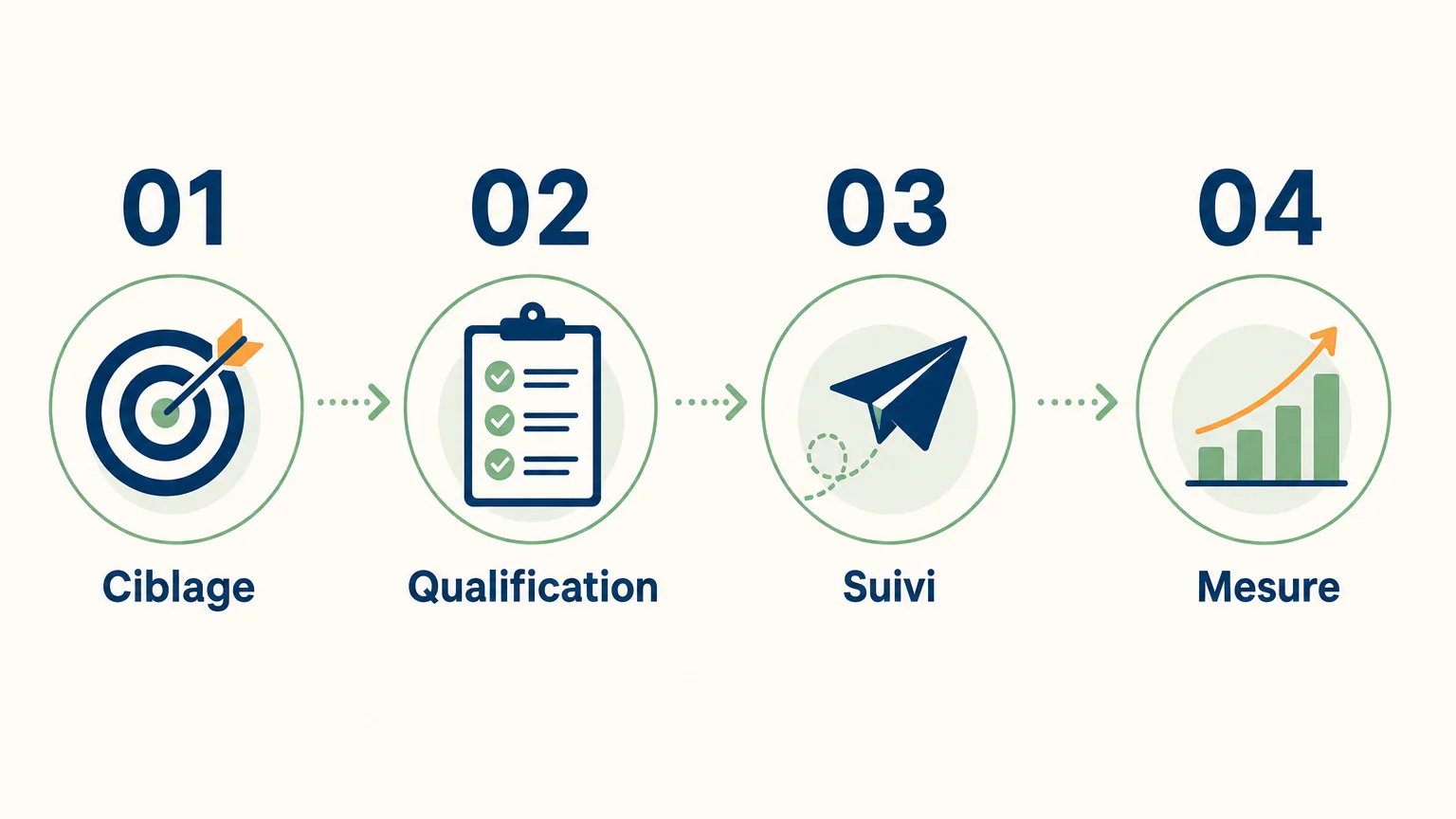
A team can only improve what it measures accurately. The number of calls or emails indicates activity, but not necessarily sales progression.
Start by tracking pipeline coverage. How many relevant new accounts enter each week? How many truly fit your target profile? How many have an identified need?
Next, measure conversions between stages. A low rate between prospecting and qualification might signal imprecise targeting. A drop between demo and proposal could reveal a value proposition issue or an internal decision-making problem.
Useful indicators include:
- number of targeted and qualified accounts;
- response rate per channel;
- conversion rate between each stage;
- average sales cycle length;
- average contract value;
- renewal and expansion rate;
- percentage of opportunities without a defined next step.
Reliable forecasting isn't built on a salesperson's optimism. It relies on observable criteria, such as validated needs, decision-maker involvement, budget agreement, and decision date.
Also, analyze lost deals. The stated reason isn't always the full story. A price deemed too high might hide poor qualification, a misunderstood timeline, or a lack of internal champion.
By 2026, teams must also measure AI's actual contribution. Time saved is valuable, but it must be linked to opportunity quality, conversion rates, and cycle length.
B2B Sales Rely on a Coherent System
An effective strategy isn't about contacting more random prospects. It's about targeting the right accounts, understanding their challenges, engaging the right stakeholders, and maintaining a valuable relationship until the decision is made. Tools and AI can reduce repetitive work, but they must remain integrated into a clear process. In 2026, the strongest teams will be those that combine reliable data, personalization, measurement, and human judgment. This makes B2B sales more predictable, without losing the relational quality that fosters long-lasting contracts.
Structure Your B2B Prospecting
When research, enrichment, writing, and follow-ups are scattered across multiple tools, opportunities can slow down. We bring these actions together in a multichannel workflow to help you dedicate more time to truly valuable conversations.

With GetCalls, you can launch a free trial without a credit card, connect your channels, and validate prepared actions before they are executed. The service unifies LinkedIn, email, and phone in a single inbox, featuring a shared workspace and usage-based pricing. Discover our B2B sales solution and adjust your volume according to your needs.
Frequently Asked Questions
What is the definition of B2B sales?
B2B sales refer to transactions made between two businesses. These involve products, services, software, equipment, or provisions intended to support a professional activity.
Why is the B2B sales cycle often longer?
The decision frequently involves multiple stakeholders, internal validations, and a return on investment analysis. The timeline also depends on the amount, risk, and complexity of the solution.
Which channels should be used for B2B prospecting?
You can combine email, phone, LinkedIn, referrals, events, and expert content. The choice depends on your target audience, industry, and the prospect's maturity level.
What metrics should be tracked in B2B sales?
Track the response rate, conversion between stages, cycle duration, average contract value, and renewal rate, among others. These metrics should be analyzed by segment and channel when volumes allow.
How can GetCalls help a sales team?
GetCalls prepares prospect research, contact enrichment, messages, and follow-ups within a multi-channel workflow. Prepared approaches remain subject to validation, while LinkedIn invitations can be automated within applicable limits.