

Can a sales team truly prospect more without sending more generic messages? Yes, provided they start with targeting quality, not volume. AI-assisted sales prospecting combines prospect analysis, contact enrichment, approach preparation, and conversation tracking. To structure this work, our sales prospecting automation helps reduce repetitive tasks while giving the salesperson control over important actions.
Artificial intelligence is most useful when it transforms scattered information into understandable next actions. It can identify an account matching the desired profile, suggest a channel, prepare a message, or indicate that a follow-up is relevant. However, it should not solely decide strategy, over-interpret a signal, or pursue a sensitive conversation without supervision.
What does AI-assisted sales prospecting mean?
AI-assisted sales prospecting refers to the use of artificial intelligence models to help teams research, qualify, enrich, and contact prospects. The term "assisted" is important: the tool prepares or recommends actions, but the salesperson generally retains control over validation, relational context, and conversion.
The scope can cover several steps. AI analyzes the value proposition, translates the target market into search criteria, identifies relevant companies, completes profiles with available data, and then prepares messages adapted to the context of each contact. It can also analyze responses and suggest a follow-up, a change of channel, or human intervention.
The definition recorded by France compétences specifically associates this approach with the creation of an ideal customer profile, the personalization of outreach, lead generation, and the optimization of sales processes. This confirms that AI-assisted prospecting is not limited to generating emails: it concerns the organization of all work leading up to the appointment.
| Approach | Main Function | Human Role |
|---|---|---|
| Classic Automation | Execute a predefined rule, for example, creating a task after a call. | Define rules and monitor results. |
| Generative AI | Write, rephrase, or summarize content from available information. | Verify facts, tone, and message relevance. |
| AI-assisted Scoring | Rank accounts based on their fit or observed signals. | Validate criteria and interpret the sales context. |
| AI Prospecting Agent | Chain multiple tasks, such as research, enrichment, and approach preparation. | Define permissions and take over for sensitive decisions. |
What tasks can AI handle?
Imagine a salesperson opening their CRM and finding hundreds of incomplete contacts. The problem isn't just the number of records. They also need to determine which accounts truly match their market, find the right contact person, understand the company's context, and choose the appropriate channel.
AI can intervene in five particularly time-consuming tasks:
- Targeting, by matching company characteristics with the ideal customer profile.
- Data enrichment, to complete a function, professional address, industry, or contextual element.
- Prioritization, by ranking prospects according to their fit and available signals.
- Message personalization, by linking verifiable information to a potential need hypothesis.
- Follow-up, by identifying unanswered conversations, lukewarm prospects, and possible next actions.
Value therefore doesn't come solely from writing speed. It comes from the continuity between steps. Enriched data must improve targeting, targeting must guide the message, the message must feed the follow-up, and the follow-up must remain accessible to the team.
This logic differs from a simple pre-written sequence. A sequence applies a defined scenario to a list. An AI-assisted approach can take known context into account, flag uncertain information, and propose a different action depending on the prospect's profile. It doesn't eliminate the need for rules, but it allows more situations to be handled without multiplying manual operations.
Why does data quality remain crucial?
Personalization based on inaccurate data produces a seemingly more precise message, but one that is less credible in reality. That's why the primary success factor isn't the model used. It's the quality of the ideal customer profile, the sources consulted, and the verification rules.
Before automating, you need to clarify:
- the truly priority sectors and company sizes;
- the functions likely to be interested in the offer;
- exclusion criteria, such as existing clients or already contacted accounts;
- the signals that warrant an outreach;
- the information that absolutely must be verified by a human.
A sales signal doesn't automatically constitute a need. A fundraising round, a recruitment, or a change in leadership can create an interesting context, but they don't prove that the company is looking for your solution. The message must therefore distinguish verified facts, hypotheses, and the question to ask the prospect.
For a small team, it's better to start with a homogeneous scope. For example, a single industry, a defined geographical area, and two priority functions. The AI can then be evaluated on a consistent basis. If the criteria change every week, the results become difficult to interpret.
When research, enrichment, and writing are still scattered across multiple tools, our sales prospecting software can serve as a central point for actions and history. The goal isn't to add a technical layer, but to prevent context from getting lost between a spreadsheet, an email inbox, and a professional messaging app.
How to personalize without turning messages into spam?
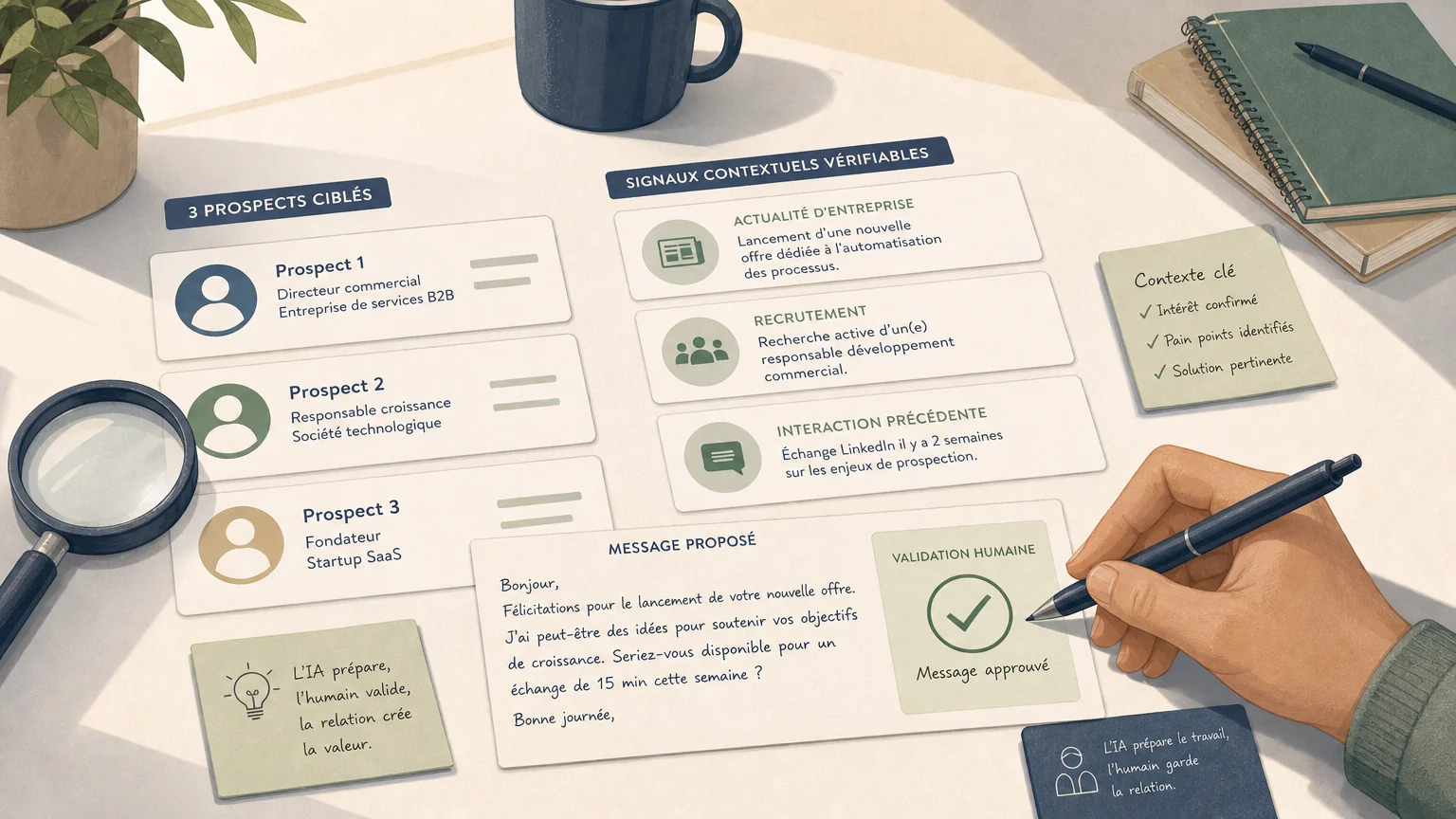
Useful personalization answers a simple question: why does this message concern this person, in this company, right now? A phrase that only uses the first name or the last published content is not enough. It must connect a fact to a potential issue, without inventing a difficulty.
A reliable structure can follow four steps:
- Start with an observable and recent fact.
- Explain the possible connection with your offer.
- Formulate a cautious hypothesis, without presenting a guess as a certainty.
- Ask a short question that allows the prospect to correct or confirm this hypothesis.
Example: a company is recruiting several salespeople. A relevant message might address the possible challenges of structuring prospecting, then ask how the team currently organizes account research and follow-up. However, it would be unwise to claim that this company is already suffering from a lack of productivity or a poorly managed CRM.
Personalization must also take the channel into account. LinkedIn may be suitable for an initial relational approach, email for developing a more precise context, and phone for quickly qualifying a situation. Multichannel prospecting is not about repeating the same message everywhere. It's about using each channel for a coherent stage of the journey.
Human review remains particularly important when a message contains sensitive data, a reference to current events, or an interpretation of a company's internal operations. A quick validation before sending can avoid an error that would be much more costly if replicated across hundreds of contacts.
How to deploy AI in a sales team?
The most prudent deployment starts with a concrete friction, not with the purchase of multiple tools. A team might, for example, choose to reduce the time spent searching for contact details, preparing initial messages, or documenting follow-ups.
A five-step method helps limit risks:
- Measure the starting situation. Note the time spent on research, the rate of complete records, the average follow-up time, and the number of truly qualified appointments.
- Choose a single use case. Start with enrichment, message preparation, or follow-up, but avoid automating everything simultaneously.
- Define permissions. Specify what the AI can consult, recommend, modify, or send. Reading and recommending are generally easier to control than autonomous sending.
- Test on a limited scope. Select a homogeneous segment, a small team, and a defined observation period.
- Compare quality, not just speed. Verify if the time saved actually leads to better conversations and more qualified appointments.
This approach aligns with the objectives presented in a CCI training course, which emphasizes measurable objectives, tool selection, commercial data exploitation, and consideration of ethical and regulatory issues.
A pilot can last a few weeks. However, it must remain reversible. If messages become too generic, if prospects are poorly targeted, or if salespeople systematically correct recommendations, the data and criteria must be reviewed before expanding the system.
In this context, our prospect sourcing and enrichment method addresses the needs of teams who want to maintain continuous research without abandoning the validation of records and proposed actions.
What metrics to track to judge performance?
Counting generated messages doesn't tell you if prospecting is progressing. A system can produce more actions while decreasing contact relevance or response quality.
Metrics can be divided into three levels:
- Productivity: time spent researching per account, message preparation time, record update time, and number of actions processed.
- Quality: proportion of accounts truly matching the ideal customer profile, valid contact rate, false positive rate, and relevant response rate.
- Commercial result: appointments accepted, appointments held, opportunities created, cost per qualified appointment, and attributable margin.
An article published in 2026 by a 2026 benchmark, citing Microsoft's 2025 Work Trend Index, mentions one to two hours saved per day thanks to AI assistants integrated into the commercial work environment. This data should be read as a productivity benchmark, not as a guarantee applicable to every company.
To measure a real effect, compare similar segments. If AI allows you to prepare twice as many accounts, but the rate of off-target appointments increases, the system has not created value. It has simply shifted the problem from research to qualification.
It's also useful to track human corrections. A high proportion of rephrased messages can reveal a problem with tone, data, or targeting criteria. These corrections are a source of learning for the team, provided they are documented and reused.
What role should an integrated prospecting workflow play?
An integrated workflow becomes relevant when the team wastes time switching between tools. The benefit is to link sourcing, enrichment, message preparation, follow-ups, and history within the same working logic.
We combine LinkedIn, email, and phone in a common inbox. From a website URL, a catalog, or an offer presentation, our agent can help deduce the ideal customer profile, search for prospects, enrich contact details, and prepare upcoming actions. Each prepared approach is presented for validation before execution.
This organization is particularly suitable for teams that want to maintain human connection while reducing manual research. The salesperson remains responsible for conversations, in-depth qualification, negotiation, and closing deals. AI works in the background on preparatory tasks and follow-up.
Credits connect cost to usage. The indicated price is €80 ex VAT for 1,000 credits. A LinkedIn action record consumes 1 credit, an email record with enriched and verified address consumes 3 credits, and a phone record with enriched number consumes 9 credits. No credit is consumed if enrichment fails.
For teams looking to structure follow-up over time, automated sales prospecting can reduce forgotten follow-ups while retaining a validation step before sensitive actions.
What to remember before getting started
AI-assisted sales prospecting creates value when it improves the quality of commercial decisions, not just when it increases the number of messages sent. Start with a precise ideal customer profile, verifiable data, and a limited use case. Then, measure time saved, targeting relevance, response quality, and genuinely qualified appointments. AI can prepare and orchestrate the work, but the relationship, discernment, and validation remain human.
Structure Your Prospecting with an AI Agent
If your team spends too much time researching prospects, preparing messages, or following up on conversations, an AI-assisted workflow can bring these tasks into a more coherent sequence. The goal is to reduce repetitive work without transforming your interactions into impersonal campaigns.
With our AI agent for sales prospecting, you can start with your offer, connect LinkedIn or your inbox, validate the positioning analysis, and review proposed actions before execution. The service brings together sourcing, enrichment, messages, follow-ups, and tracking into a single inbox. Try the AI agent for sales prospecting with 500 credits unlocked after setup and validation of a first campaign, no credit card required.
Frequently Asked Questions
Does AI replace sales reps in prospecting?
No. It can handle part of the research, enrichment, writing, and follow-up, but the sales rep remains essential for understanding challenges, managing objections, and building relationships.
What's the difference between traditional automation and AI prospecting?
Traditional automation executes a predefined rule. AI can interpret information, provide a recommendation, or adapt an action to a context, with a level of control that must be defined by the team.
What data should be prepared before deploying an AI tool?
Start by formalizing the ideal customer profile, exclusion criteria, targeted functions, and relevant commercial signals. Contact data must then be verified, and its origin documented according to the context of use.
How do you measure the success of AI-assisted prospecting?
Track research time, data quality, relevance of targeted accounts, positive responses, qualified appointments, and cost per opportunity. The volume of messages generated is not sufficient to evaluate performance.
What does GetCalls offer for this type of prospecting?
We combine sourcing, enrichment, message preparation, follow-ups, and tracking from LinkedIn, email, and phone into a single inbox. Actions prepared by AI are presented individually so that the user can validate them before execution.