
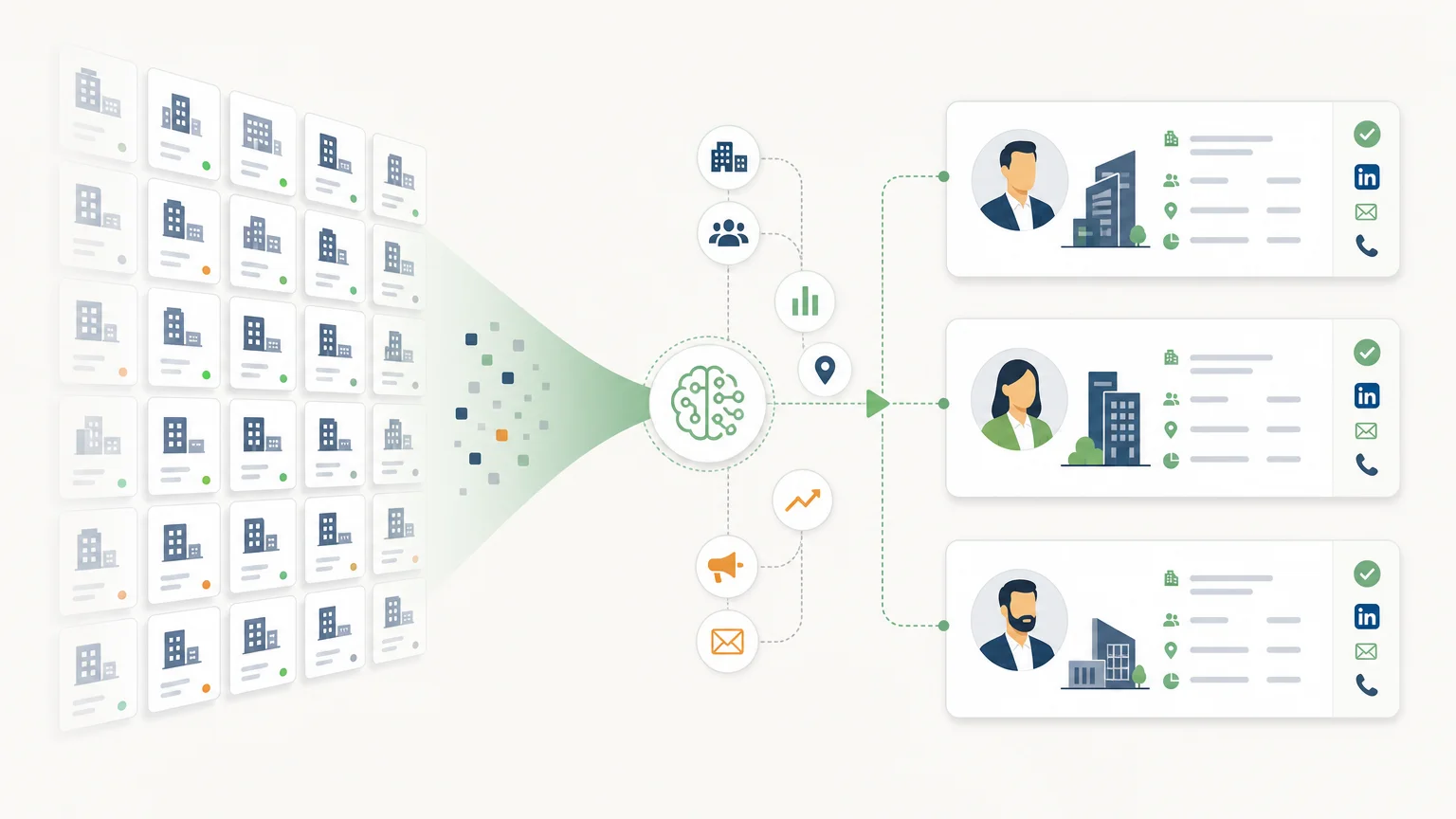
How much time can a sales team dedicate to finding companies, verifying roles, retrieving contact details, and preparing each message? Without a method, prospecting becomes a series of manual searches and inconsistent follow-ups. To reduce this repetitive work, automating prospecting can help prepare actions while allowing the salesperson to maintain control of the relationship.
Prospect sourcing and enrichment precisely address this problem. Sourcing identifies companies and contacts that match a target profile. Enrichment then completes the available information with data useful for qualification, personalization, and channel selection. The goal isn't to accumulate records, but to have reliable context before writing, calling, or sending an invitation.
What is the purpose of a prospect sourcing and enrichment service?
Imagine a list containing only a company name, a contact's first name, and their supposed role. This list might seem usable, but it doesn't yet answer essential questions: Does the company fit the desired profile? Is the contact still in that role? Do you have a verified professional address? Is there a signal that justifies outreach now?
A sourcing and enrichment service brings these different steps together. It can search for companies based on an ideal customer profile, identify contacts, complete firmographic data, and add contact details when available. It can also contextualize the record with information such as industry, size, location, technology used, or a recent event.
The value lies in transforming raw data into actionable information. An enriched record should allow you to decide who to contact, why this person is relevant, what message to prepare, and what channel to use. It doesn't guarantee a response or a sale, but it reduces the risk of prospecting blindly.
Sourcing, enrichment, cleaning, and prospecting: what are the differences?
The same file may require several treatments, but these treatments do not pursue the same objective. Confusing them often leads to purchasing too broad a database, enriching off-target contacts, or launching campaigns on unverified data.
| Process | Objective | Concrete example |
|---|---|---|
| Sourcing | Identify companies and contacts matching a target | Search for sales directors in small and medium-sized service businesses |
| Enrichment | Add useful information to the existing profile | Complete industry, headcount, role, and professional address |
| Cleaning | Correct, standardize, or delete erroneous data | Detect a duplicate or remove an invalid address |
| Prospecting | Initiate contact with the prospect and follow up on the exchange | Send a personalized message, call, or follow up |
Sourcing answers the question "who to target?". Enrichment answers the question "what do we need to know about this target?". Cleaning verifies that existing information remains consistent. Prospecting then follows, with initial contact and sales follow-up.
This distinction aligns with the findings of a B2B report on sales and marketing data quality: incomplete or incorrect information can affect prospecting, segmentation, and sales closure. In practice, a campaign cannot sustainably compensate for a poorly targeted or maintained database.
What data should be prioritized for enrichment?
Should you seek out the maximum amount of information on each prospect? No. Priority should be given to data that genuinely alters a sales decision. An attribute is useful if it allows for better filtering, better prioritization, personalization of the message, or selection of the right contact person.
Company data
Firmographic information is used to verify the suitability of the targeted company with your ideal customer profile. The most common are industry, size, location, legal structure, number of establishments, geographic area, and, when relevant, an estimate of maturity or growth level.
This data prevents, for example, treating a young company of 15 employees, a multi-site mid-market company, and a large international account in the same way. It also allows for the creation of more coherent segments, the distribution of accounts among several sales representatives, and the construction of messages that truly speak to the company's context.
Contact data
For an individual, job title, seniority level, department, location, and professional contact details are often priorities. However, it's important to distinguish between found data and verified data. An outdated title or an unchecked address can lead to misleading personalization and degrade campaign quality.
The goal is not just to find an email address. It also involves identifying key decision-makers and the people who truly influence the purchase. Depending on the complexity of the offering, several contacts may be relevant, for example, a business user, a budget manager, and a final decision-maker.
Commercial signals
Contextual data can make a target more actionable. This could involve strategic hiring, a new site opening, a change in management, fundraising, a new offering launch, or a visible organizational change. These signals don't prove an imminent purchase, but they provide a concrete reason to engage in conversation.
A prospect who matches your target but shows no identifiable context can still be relevant. A prospect who matches your target and is undergoing a change related to your solution often deserves higher priority. The correct use is to treat these signals as indicators, never as guarantees of conversion.
How does an effective workflow operate?
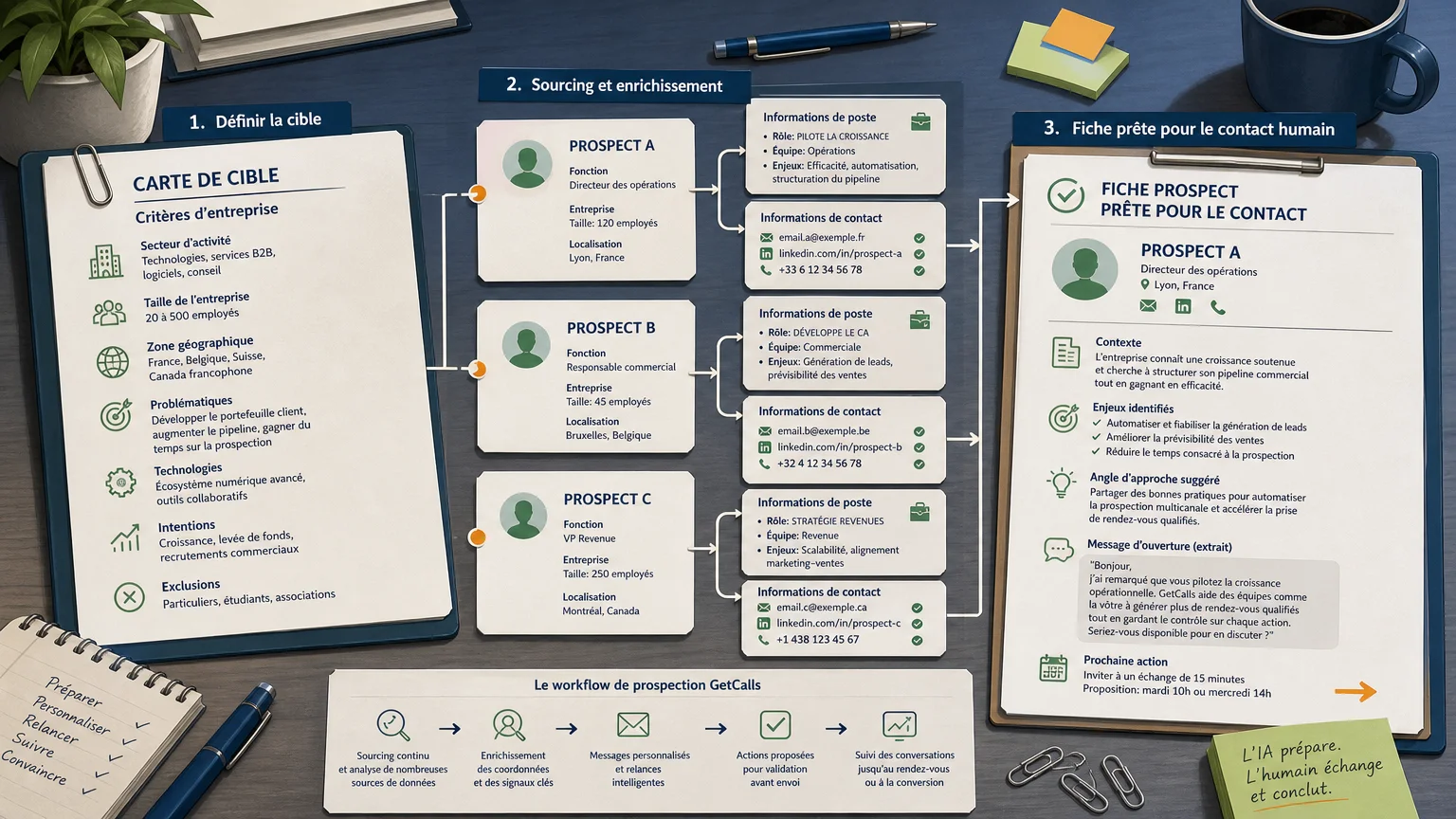
The most reliable scenario begins before contact research. First, you need to formalize the offer, the companies sought, the target positions, exclusions, and the signals that justify an approach. Without this framework, the tool or team risks producing a voluminous but difficult-to-exploit list.
- Define the ideal customer profile: industry, size, area, business model, needs, and exclusions.
- Search for target accounts: identify companies that match the selected criteria.
- Associate the right contacts: search for relevant functions and decision-making levels.
- Enrich records: complete contact details, firmographic data, and contextual information.
- Quality control: verify freshness, duplicates, errors, and consistency of sources.
- Prepare the approach: choose the channel, draft a contextualized message, and plan follow-up.
- Validate and follow up: maintain human validation and centralize exchanges.
This organization avoids artificially separating research, enrichment, and outreach. It also facilitates lead management, as useful information, planned actions, and history can remain linked to the same record.
Centralization does not mean that all actions must be executed automatically. A good practice is to let automation prepare the next steps, then give the salesperson the option to review, modify, or decline an action before its execution.
How to verify data quality and freshness?
Complete data is not necessarily reliable data. A record may contain an email address, phone number, and job title yet be unusable if the contact has changed companies or if the information comes from an old source.
Data quality is based on four complementary criteria: accuracy, completeness, freshness, and relevance. It is better to have fewer well-verified records than a large volume of poorly targeted contacts. The measurement should therefore focus on the rate of exploitable data, duplicates, contact errors, sales feedback, and results per segment.
It is also useful to distinguish levels of confidence. Information directly declared by the prospect does not have the same status as information deduced from a public source. A verified professional address should not be presented in the same way as an address merely assumed from a company format.
The reuse of public data also requires caution. The CNIL reminds of the rules applicable when personal data accessible online is used to build or enrich prospecting files. The fact that information is visible does not mean that it can be collected, stored, and used without verifying the purpose, proportionality, and rights of individuals.
What GDPR precautions should be taken in 2026?
The B2B context does not exempt from respecting the GDPR. As soon as information allows an individual to be identified, such as a name, a nominative email address, a direct number, or a professional profile, it must be processed within a documented framework.
The CNIL specifies prospecting rules according to the channel and type of recipient. For professionals, electronic prospecting may be possible when the person is informed and can easily object. Conditions differ for individuals and may also evolve depending on the channel used.
Before initiating enrichment, it is therefore necessary to specify the purpose, choose an appropriate legal basis, limit the data collected, and provide an objection mechanism. Prospects must also be informed of the use of their data, especially when the information comes from an external source.
Subcontracting requires particular verification. A CNIL decision published on Légifrance reminds us that a simple contractual commitment from a supplier to comply with GDPR is not always enough to demonstrate that collection and consent practices have been controlled. It is therefore relevant to examine sources, responsibilities, security measures, international flows, and data processing clauses.
The retention period must also be defined. The guidelines published by the CNIL for commercial management suggest a period of three years from collection or the last contact from the prospect in relevant situations. This rule must be placed in the specific context of processing and accompanied by a purge or archiving procedure.
How to choose a sourcing and enrichment service?
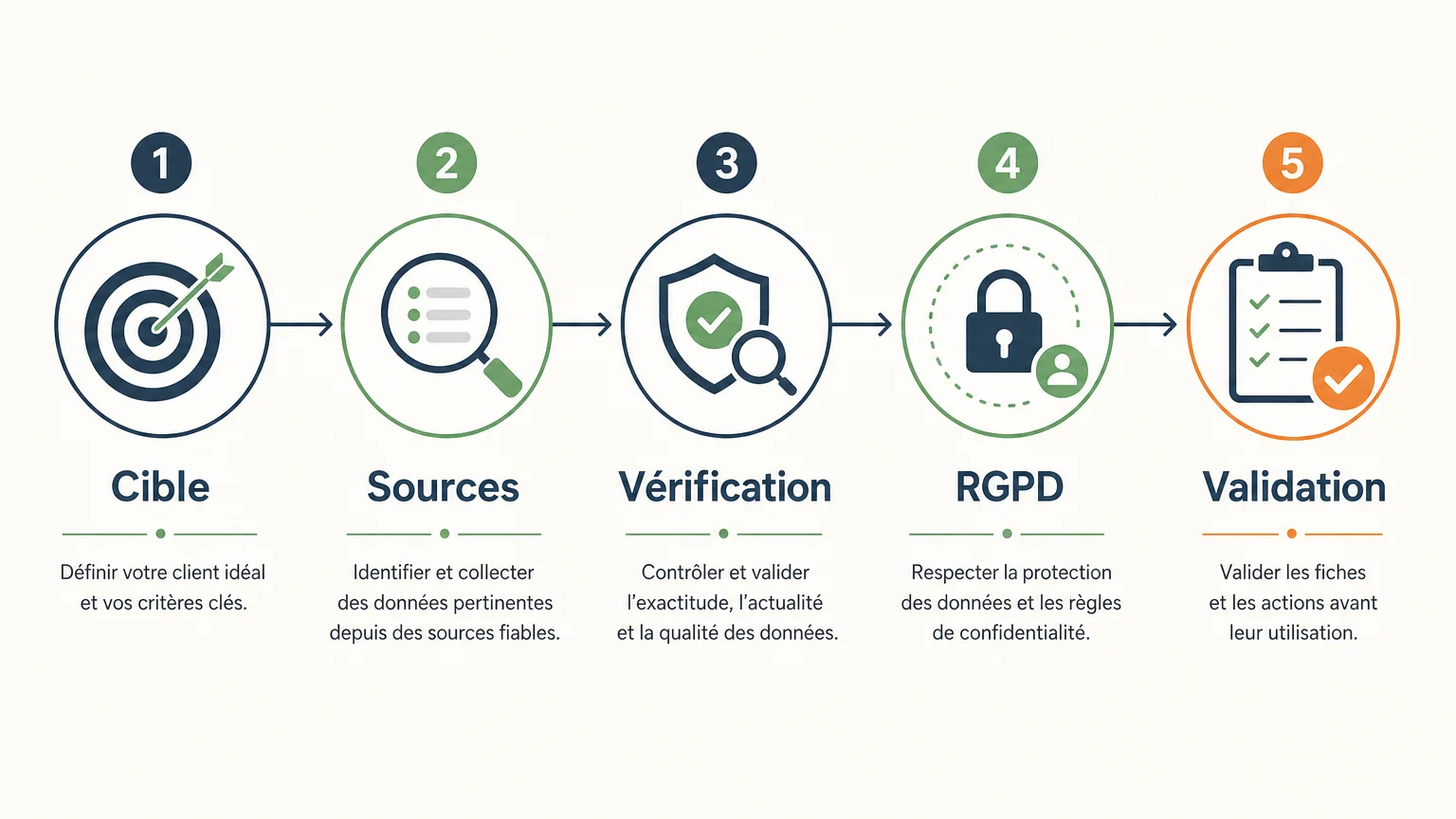
The right service depends less on the number of available fields than on their utility for your sales process. Before comparing solutions, describe your starting point and the expected outcome. Are you looking for new companies, missing contact details, decision-makers, commercial signals, or complete multi-channel execution?
- Target coverage: Does the service work with your priority industries, countries, company sizes, and functions?
- Data freshness: Is the information verified, updated, and accompanied by a confidence level?
- Enrichment depth: Can you obtain the truly necessary data, without over-collection?
- Signal management: Does the service account for changes that might justify an approach?
- Human validation: Can you review messages and actions before they are executed?
- Centralization: Do exchanges, follow-ups, and data remain accessible in a common history?
- Economic model: Does the price match the volume and channels you actually use?
- Governance: Are hosting, security, documentation, and responsibilities clearly presented?
At our company, the workflow combines continuous sourcing, analysis of numerous data sources, contact detail enrichment, message preparation, and conversation tracking. Our AI agent for prospecting prepares actions, but each approach can be presented individually for validation before execution.
LinkedIn, email, and phone are brought together in a single inbox with a contextual history. This approach suits teams who want to avoid switching from a research tool to a writing tool, then to another follow-up tool. It does not eliminate the salesperson's role, who remains responsible for validation and the relationship with the prospect.
In 2026, our pricing is usage-based. 1,000 credits cost €80 ex VAT, with consumption varying by action: 1 credit for a LinkedIn profile, 3 credits for an email contact with an enriched and verified address, and 9 credits for a phone contact with an enriched number. No credits are charged if enrichment fails, and the volume can be adjusted or stopped without commitment.
Measuring the effectiveness of the system after launch
A sourcing and enrichment service should not be evaluated solely by the number of profiles produced. Volume is useful if it fuels prospecting that is better targeted, faster, and more consistent with your sales process.
First, track operational indicators: time spent on research, rate of complete profiles, duplicate rate, proportion of verified contact details, time between identification and the first action, number of follow-ups performed, and proportion of contacts requiring human correction.
Then, add commercial indicators. Compare segments by response rate, conversation quality, number of relevant appointments, and progression through subsequent stages of the sales cycle. An enriched database can improve preparation without immediately generating more signatures. Therefore, it's necessary to separate process quality, conversation relevance, and the final outcome.
Finally, create a feedback loop between sales representatives and the system. Recurring errors often indicate that a targeting criterion is poorly defined, a source is insufficient, or a signal is interpreted too broadly. Sourcing then becomes a continuous learning process, rather than a one-off contact extraction.
Key takeaways
Prospect sourcing and enrichment helps build a targeted, contextualized, and actionable database before initial contact. The most robust method combines a precise ideal customer profile, verified data, commercial signals, GDPR governance, and human validation. Choose a service capable of linking research, enrichment, and follow-up, then measure its value by the quality of conversations, not just the volume of profiles.
Structure your prospecting based on useful data
When research, enrichment, and follow-ups are separated, context is easily lost. A centralized workflow can help your team spend more time on conversations and less on repetitive preparation.
With our solution, you can start without a credit card and unlock 500 credits after account setup and validation of a first campaign. In 2026, usage-based operation allows you to adapt your budget to the chosen volume. Discover our sales prospecting software to unite sourcing, enrichment, and follow-up in one place.
Frequently Asked Questions
What is the difference between prospect sourcing and enrichment?
Sourcing involves identifying companies and contacts that match a target. Enrichment then completes their profiles with information useful for qualification, personalization, and channel selection.
What data should be enriched first?
Start with information that influences a business decision, such as industry, company size, job title, seniority, professional contact details, and contextual signals. Avoid collecting data that serves no specific action.
Is prospect enrichment compatible with GDPR?
It can be if the purpose, legal basis, data source, minimization, data subject information, and right to object are properly managed. The fact that data is public is not enough to authorize all commercial uses.
Should prospecting be fully automated after enrichment?
No. Automation can research, complete, and prepare actions, but human validation remains important to control the relevance of targeting and messaging. With us, prepared actions can be reviewed before execution.
How do you measure the quality of a sourcing and enrichment service?
Measure the freshness and completeness of data, contact errors, time saved, response quality, and opportunity progression. The number of prospects found is not sufficient to evaluate the true value of the system.