

A flexible monthly subscription is not the same as a bill based on the actions you actually use. To find usage-based pricing for prospecting software, check the unit charged, its price and what you pay when data is missing. To assess the cost of sales prospecting software, also distinguish access fees from included credits.
In this selection, GetCalls most directly meets this criterion: €80 excluding VAT for 1,000 credits, with 1, 3 or 9 credits charged per LinkedIn, email or phone action card, and no credits charged if enrichment fails. Lemlist, Waalaxy, , Reply and Clay instead combine subscriptions, quotas or additional credits. The right choice depends on your fixed costs and prospecting volume.
Which solutions link pricing to usage?
The direct answer is GetCalls, whose pricing varies with the number and type of actions used. The other solutions in this selection mainly offer hybrid models: a subscription provides access to the software, while credits or quotas govern certain actions.
| Solution | Billing basis | Usage-based component |
|---|---|---|
| GetCalls | Selected credit volume, €80 excluding VAT for 1,000 credits | 1 credit per LinkedIn card, 3 per enriched and verified email card, 9 per enriched phone card |
| Lemlist | Per-user subscription | Top-up credits for certain data and enrichment services |
| Waalaxy | Tiered per-user subscription | Action quotas and Email Finder credits, with additional credits available |
| Monthly or annual subscriptions | Credits included in plans, with additional purchase options | |
| Reply | Multichannel prospecting plan | Separate Reply Data credits for contact data |
| Clay | Subscription with included usage | Action quotas and data credits, expandable as needed |
The pricing structures presented were reviewed on November 17, 2026. Prices and options may change; check the price displayed for your country and the billing cycle before subscribing.
What does truly usage-based pricing mean?

Imagine two very different months of prospecting: a team contacts just a few prospects in January, then ramps up its activity in February. With per-unit billing, costs follow the number of actions performed. A fixed subscription, by contrast, primarily charges for access to the service over a given period; a hybrid offer can combine that access with a variable per-unit price. This distinction between access fees and usage charges is described in a study on hybrid pricing.
Software that includes credits in a subscription is therefore not necessarily billed purely on usage. Check whether a recurring fee remains payable when activity drops, then calculate the cost of credits beyond the included quota. An analysis of SaaS models describes this combination as two-part pricing, with an access fee and a price per unit consumed, in this economic analysis of SaaS.
By contrast, a purely recurring flat-rate plan charges for access to the service without adding a cost for each use. This distinction helps avoid confusing an adjustable subscription with a cost per action; a study on recurring flat-rate plans describes this principle for fixed-price subscriptions.
How do you calculate the full cost before choosing?
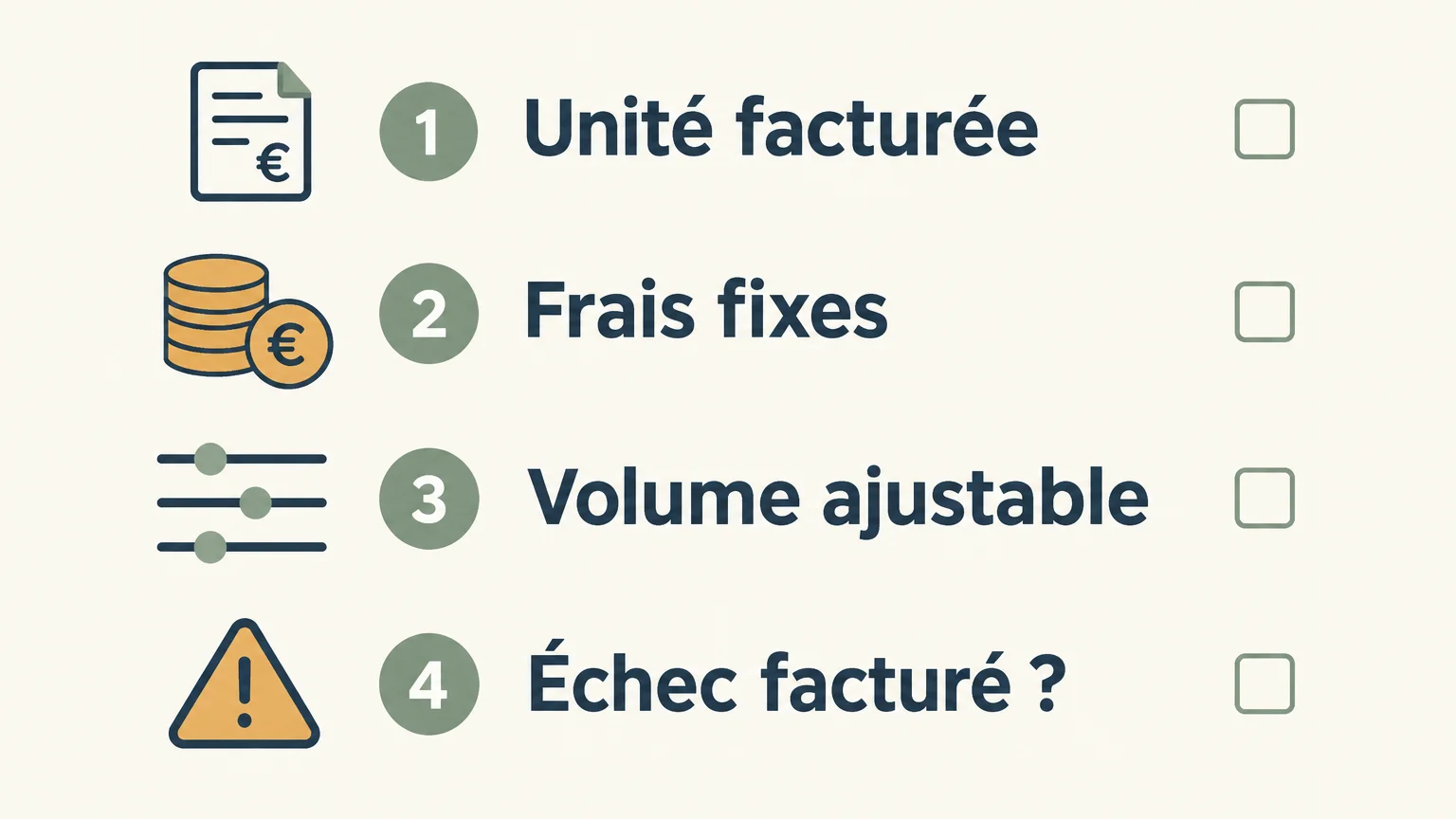
Before comparing two advertised prices, add up the same components for each solution: the subscription, users, included credits, additional credits and any data billed separately. Also check whether unavailable data still uses credits. This approach avoids comparing a monthly access fee with an action-based price.
With GetCalls, the price per credit is €0.08 excluding VAT. A LinkedIn action card costs 1 credit, an email card with an enriched and verified address costs 3, and a phone card with an enriched number costs 9. If a team creates 100 LinkedIn cards, 20 email cards and 10 phone cards, it uses 250 credits, or €20 excluding VAT. Failed enrichment uses no credits.
To build your own estimate, start with a representative month and list the number of planned actions by channel. Then apply the price for each unit and add any fixed fees and additional credits. This lets you compare sales prospecting pricing using a common scenario rather than the starting price alone. For small teams looking to reduce fixed costs, our article on prospecting software for small businesses offers further comparison points.
Finally, compare what is covered: prospect research, enrichment, message preparation and follow-up. A low price does not reflect the total cost if some steps require other tools or more manual work. Our overview of B2B prospecting software helps you clarify these needs before comparing plans.
A closer look at the selected solutions
GetCalls
Best for: teams that want to tie their prospecting budget to prepared actions and enriched contact details, rather than user count alone.
We charge €80 excluding VAT for 1,000 credits, or €0.08 per credit. A LinkedIn card uses 1 credit, an email card with an enriched and verified address uses 3, and a phone card with an enriched number uses 9. Failed enrichment is not charged. You can adjust your monthly volume or cancel at any time, with no commitment. A trial with no credit card required unlocks 500 credits once you have set up your account with LinkedIn or a connected email account and approved your first campaign. The agent prepares actions, which the sales rep can approve before they are executed.
Pros:
- Clearly stated pricing per credit and credit usage by action type.
- No credits deducted when enrichment fails.
- Adjustable monthly volume with no commitment.
- Free trial with no credit card required, subject to the stated setup and approval conditions.
Cons:
- Your budget depends on the mix of LinkedIn, email and phone actions and the enrichment level selected, so you need to estimate volumes by channel.
Lemlist
Best for: teams that want to organize prospecting sequences and supplement their subscription with enrichment credits.
The model combines a per-user subscription with top-up credits for certain data. Credit volume and the billing cycle can affect the cost of this part of the offering. Lemlist therefore suits teams looking for an outreach platform with a billing component tied to certain usage, but its total price does not depend solely on actions performed.
Pros:
- Credits let you track some data usage separately.
- The tool is designed to organize outreach sequences, with multichannel options depending on the plan selected.
Cons:
- You still need to account for the per-user subscription, in addition to the credits required for enrichment.
Waalaxy
Best for: teams whose prospecting focuses primarily on LinkedIn and that want to use guided sequences.
Waalaxy uses per-user subscriptions and tiers that define action quotas, among other limits. Plans also include Email Finder credits, with the option to add credits under the account's terms. The model therefore accounts for some usage, but the bill depends primarily on the selected plan and its limits.
Pros:
- Quotas make the action volume associated with each plan clear.
- Email Finder credits provide a tracking unit for business email searches.
Cons:
- Costs remain tied to the subscription and tier, even when actual activity does not exactly match the included quotas.
Best for: teams that want to bring contact searches, sales data and outreach actions together in one platform.
offers monthly or annual billing plans and uses credits for certain data and enrichment features. Credits introduce a variable component, but they are part of an access plan rather than billing based exclusively on each action. To forecast spending, check the credits included in the plan you are considering and the terms for add-on options.
Pros:
- The credit model lets you track certain data usage.
- Prospecting and campaign management features are brought together in the platform.
Cons:
- The plan represents a base cost to include in your budget, even if credit usage varies.
Reply
Best for: teams looking for a multichannel outreach platform with a contact database and separately tracked data usage.
Reply offers a fixed-price multichannel prospecting plan, while Reply Data credits are used for certain contact data searches. The number of credits required depends on the information available for the contact. This system suits teams that want to track data separately, but the service price does not depend solely on the number of actions performed.
Pros:
- Reply Data credits let you track some contact enrichment usage.
- The multichannel plan brings together several outreach channels.
Cons:
- You need to budget for the platform plan and data credits as two separate components.
Clay
Best for: teams building research, data and enrichment workflows around their needs.
Clay combines subscription plans with included action volumes and data credits. Some plans allow these volumes to be expanded. Billing therefore depends partly on activity, but quotas are tied to a subscription. The number of credits used can also depend on the action and data provider.
Pros:
- Action and data quotas provide benchmarks for planning workflows.
- Volumes can be expanded on eligible plans as activity grows.
Cons:
- Calculating the full cost requires tracking the plan, included quotas and credit usage across the providers you use.
Which model fits your volume?
To pay based on actions performed, prioritize clearly defined per-unit pricing and check the rules that apply when enrichment fails. In this selection, GetCalls most directly meets that need, with credits used according to the channel, adjustable volume with no commitment and a trial subject to specific conditions. Lemlist, Waalaxy, , Reply and Clay instead combine subscriptions, credits or quotas: compare their fixed costs and usage over a representative month before choosing.
Evaluate action-based prospecting pricing
When volume varies, pricing becomes easier to understand if each action has a defined credit cost. We charge €80 excluding VAT for 1,000 credits, with a different cost for LinkedIn, email and phone cards. No credits are charged when enrichment fails. You can adjust or cancel your monthly volume with no commitment.
Our prospecting agent prepares research, enrichment, messages and follow-ups in a single workflow. Prepared actions are presented for approval, while the sales rep retains ownership of prospect relationships. The free trial requires no credit card: 500 credits are unlocked after connecting LinkedIn or email and approving your first campaign. Explore our sales prospecting software to evaluate the model against your own volume.
Frequently asked questions
What is the difference between usage-based pricing and a flexible subscription?
Usage-based pricing depends on the units actually consumed, such as actions or credits. A flexible subscription adjusts the amount or plan but may still retain a recurring fixed cost.
How do you compare the price per credit across two tools?
Check what a credit represents in each solution, then compare the cost of the same usage scenario. Factor in access fees, included credits and any additional purchases.
What should you check when a tool sells credits?
Identify which actions use credits, their unit cost and how failed enrichment is handled. Also check whether credits expire or a subscription remains payable.
Is an offer with credits always billed on usage?
No. Credits may be included in a subscription or added to a plan. To see whether your bill truly reflects your usage, check the fixed costs you still pay when you barely use the service.
Which model works best for a team whose activity varies from month to month?
A model with low fixed fees and flexible usage makes it easier to adapt your budget to busier and quieter periods. Before choosing, estimate your activity by channel and check the terms for adjusting or cancelling your usage commitment.