
How can you prospect more effectively without sending more impersonal messages? AI for prospecting can accelerate research and preparation, provided it supports a clear commercial strategy. To develop this approach end-to-end, our AI-assisted sales prospecting method emphasizes context and the relevance of actions.
The time spent on this task remains a challenge: HubSpot's 2026 Sales Report indicates that 49% of surveyed sales professionals still dedicate at least two hours a day to prospecting. AI can reduce some repetitive tasks, but it alone does not determine who deserves to be contacted or what to tell them. Quality depends on targeting, available information, and the control exercised before sending. The 2026 Sales Report provides this benchmark within the context of sales practices in Europe and the EMEA region.
What can AI do in a prospecting process?
A sales team can use AI to assist several tasks that precede and follow initial contact. Research helps identify companies matching a target. Analysis can then summarize accessible information and suggest elements to verify. Finally, generative AI can prepare a draft email, a LinkedIn message, or a follow-up based on the provided context.
These roles are not interchangeable. A conversational tool can draft a message from given information but does not necessarily provide a contact list or continuous follow-up. An integrated system can link research, enrichment, and action preparation, while a scoring mechanism helps prioritize leads. In both cases, a score is an indication to be examined, not proof that a prospect is ready to buy.
For these aids to be useful, start by defining your ideal customer profile: sectors, company size, relevant functions, geographic area, and exclusion criteria. AI does not correct vague targeting; instead, it risks applying that vagueness to more contacts. If the priority is to refine your target, our resource on finding qualified prospects can help structure this step.
A relevant workflow connects research, context, and action

Imagine a company that sells a service to industrial SMEs. A system can search for companies matching the criteria, complete certain records when relevant information is available, and then suggest an angle for initial contact. The salesperson then verifies that the facts are accurate, that the offer genuinely addresses the observed context, and that the message doesn't attribute an unexpressed intention to the prospect.
A solid process generally follows four steps: define the target and exclusions, search for prospects, verify useful information, then prepare an action and ensure its follow-up. Follow-up must take into account received responses and cease when no longer relevant. This sequence reduces the risk of repeating the same message or following up with a contact who has already responded.
The difference often lies in the sequence rather than just the drafting. A 2026 McKinsey B2B survey, conducted with nearly 4,000 buyers and sellers in 13 countries, indicated that 22% of surveyed organizations had fully deployed generative AI capabilities and 31% were in the process of adoption. McKinsey also highlights that fragmented data and manual processes can limit the value created: adding a tool to a poorly organized workflow is therefore not enough.
When repetitive tasks are dispersed among several tools, a common workflow can facilitate follow-up. At GetCalls, we bring LinkedIn, email, and phone together in a single inbox and a shared history. Prepared actions are presented for validation; AI orchestrates the work, while the team maintains control over commercial exchanges. To delve deeper into the role of these processes, consult our page on prospecting automation.
What checks should you maintain before making contact?
An enriched record is not automatically accurate or actionable. Verify the contact's current role, the company's consistency with your target, and the source of the elements used to personalize the message. If AI suggests a piece of news, a project, or a need, confirm it before using it: an opening built on incorrect information can harm the relationship from the very first exchange.
Control also concerns the relevance of the channel, the frequency of solicitations, and the consideration of opt-outs. In France, the CNIL distinguishes applicable rules based on the audience and channel: for B2B electronic prospecting, professionals must notably be informed and able to object to the solicitation. The rules for telemarketing to consumers evolved on August 11, 2026. Automation does not exempt the company from verifying its practices against the rules applicable to its campaign.
It is useful to set concrete limits: what sources can be used, what data should not be transmitted to a tool, what actions require validation, and in which cases a follow-up should stop. Generated messages should remain drafts until the team has verified their accuracy, tone, and suitability for the recipient.
How to measure the usefulness of AI for prospecting?
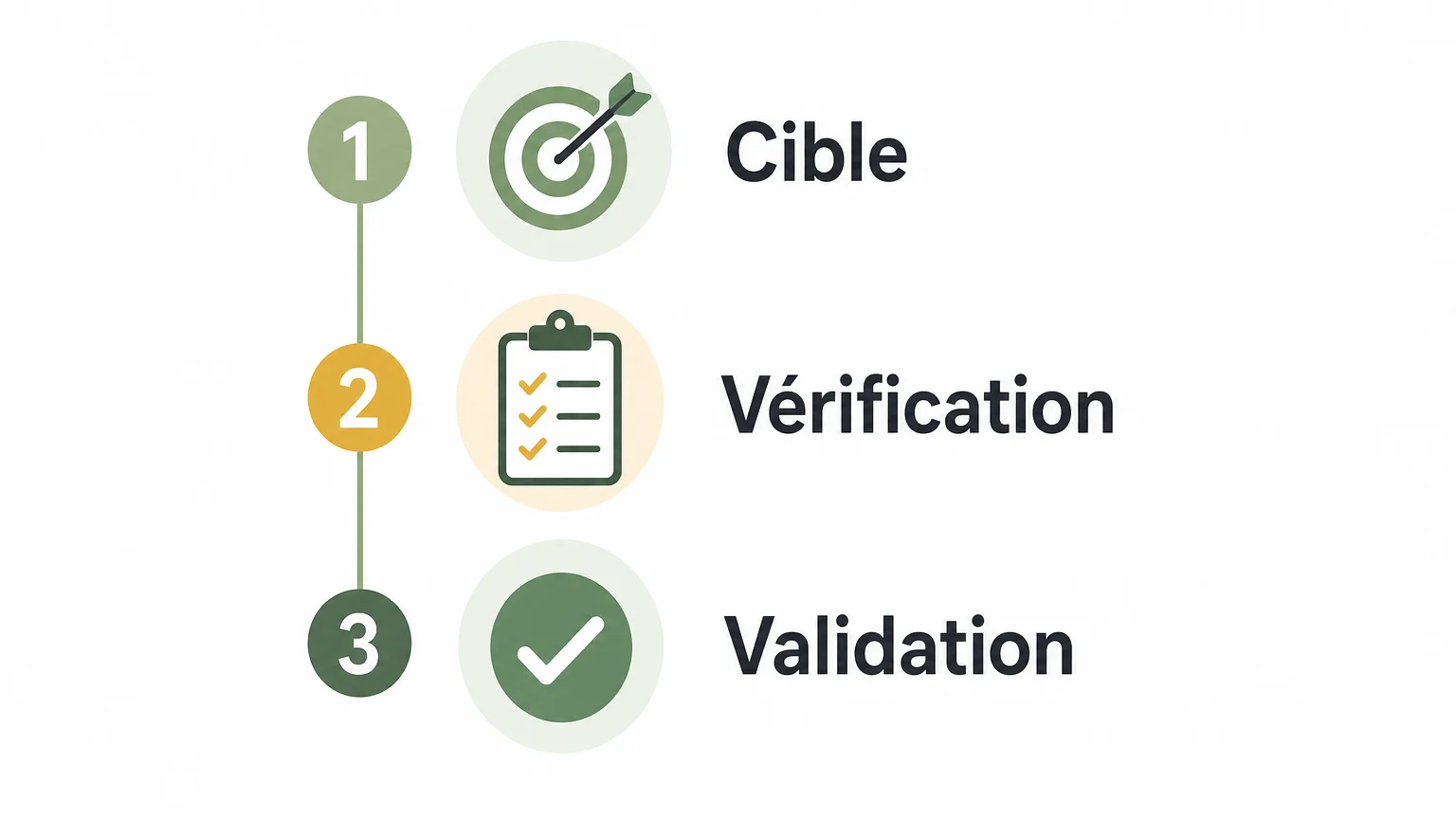
The number of contacts processed is not enough to evaluate a tool. Instead, track several indicators over a comparable period and scope: verifiable lead rates, relevance of selected prospects, responses obtained, appropriately performed follow-ups, and time spent correcting drafts. Also examine errors, duplicates, and accounted-for opt-outs.
Start with a limited test on a specific target. Compare the AI-assisted process with your usual method, maintaining identical criteria and timeframe. If data quality declines or if salespeople spend all their time correcting messages, revise the instructions, sources, or targeting criteria before expanding usage.
An integrated solution can be relevant if the main hindrance is the constant switching between research, writing, and follow-ups. For this need, our automated prospecting approach allows these actions to be unified in a single journey, with shared tracking and human validation of prepared actions.
Making AI a support, not an autopilot
AI provides concrete assistance when it connects defined targeting with verified information, contextualized messages, and consistent follow-up. To get started, choose a repetitive step, set control rules, and measure the quality of exchanges as much as the time saved. The decision to contact, the verification of context, and the relationship with the prospect remain commercial responsibilities.
Prepare your prospecting with an AI agent
If your team wastes time searching for contacts, preparing messages, and tracking follow-ups across multiple channels, a unified journey can simplify this work without replacing commercial exchanges. Our service prepares actions and presents them for validation, with LinkedIn, email, and phone united in a single inbox.
You can try our AI agent for prospecting without a credit card. After account configuration, connecting LinkedIn or email, and validating a first campaign, 500 credits are unlocked. Credits are billed on usage: €80 excluding VAT for 1,000 credits, with a monthly volume that can be modified or canceled without commitment.
Frequently Asked Questions
What does it mean to use AI for prospecting?
It involves leveraging AI tools to assist tasks such as research, qualification, drafting, or tracking prospects. The scope varies depending on the tool and the controls in place.
Can AI find qualified prospects?
It can help search and sort contacts according to defined criteria. However, qualification must be verified by the team, as incomplete or incorrect data can skew the results.
Can ChatGPT be used to write prospecting messages?
Yes, a conversational tool can prepare a draft based on information about the offer, the target, and the prospect's context. Proofread the message and verify the facts before sending it.
Should message sending be automated?
Not necessarily. It is often prudent to start by automating research or preparation, then maintain human validation before sending and follow-ups.
Can GetCalls' offer be tried before choosing a paid volume?
Yes. We unlock 500 credits after account configuration, connecting LinkedIn or email, and validating a first campaign, without a credit card.