
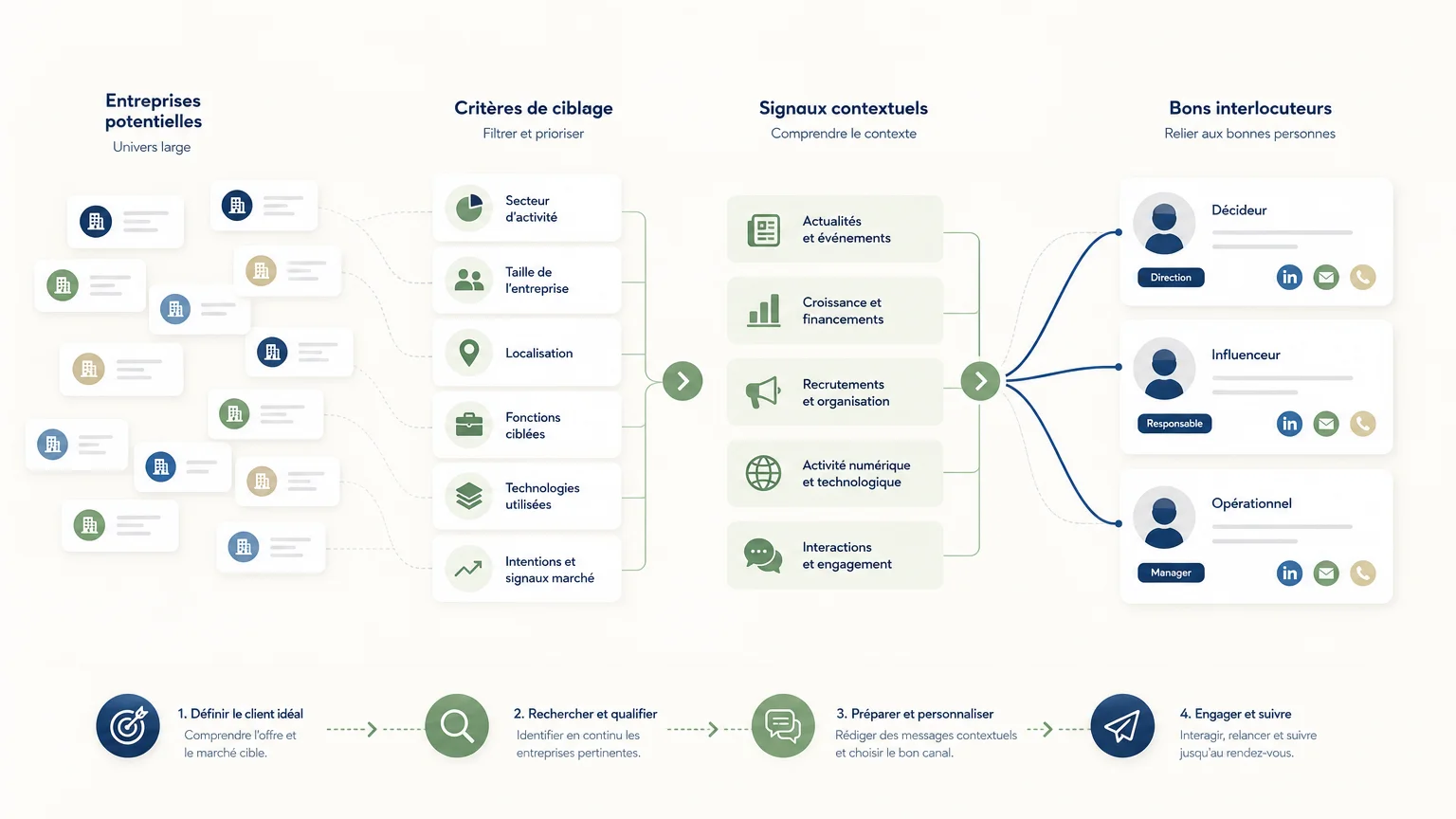
Why contact hundreds of people if only a few genuinely match your offering? To find qualified leads, the starting point isn't contact volume, but targeting precision. A shorter list, built using verifiable criteria, generally provides a better foundation for personalizing interactions and protecting sales time. To speed up contact research and verification, we can also leverage our method for lead sourcing and enrichment.
In 2026, prospecting must also consider the channel used, data quality, and applicable regulations. France Num reminds us that rules differ depending on the type of prospect and the communication method used. An effective approach therefore combines commercial targeting, contact verification, personalization, and respect for opt-out possibilities.
What is a qualified lead?
A contact isn't automatically a qualified lead just because their name appears in a file. A qualified lead is an individual or company that matches your target, has a problem your offering can solve, and presents a realistic possibility of purchase.
Qualification relies on several levels. A contact might be in the right industry but lack the necessary budget. They might have a real need but not be involved in the decision. They might also match your target and be interested, yet have no reason to act now.
Sales qualification therefore involves verifying the combination of four elements:
- Suitability with your ideal customer profile, including industry, size, geographical area, or maturity level.
- Identified need, with a problem concrete enough to warrant a discussion.
- Purchasing capacity, which includes budget, available resources, and the ability to fund the project.
- Relevant timing, with a deadline, a trigger, or a priority that makes the interaction useful now.
You can add a fifth criterion, often overlooked: the ability to reach the right interlocutor. A company might be perfectly targeted, but your approach will remain ineffective if you contact someone with no influence on the subject.
Define your ideal customer profile before searching
Imagine two companies selling the same solution. The first searches for all companies in an industry. The second only targets companies of a specific size, facing a documented problem, using certain tools, and having recently initiated a project. The second has a much more actionable framework for finding the right leads.
The Ideal Customer Profile, or ICP, describes the company that derives the most value from your offering and presents the best conditions for purchasing. It shouldn't remain a general description like "French SMEs." It must become a concrete search grid.
To build it, first analyze your current best customers. Look for commonalities among accounts that signed quickly, genuinely use your solution, remain customers, and achieve good results. Specifically note:
- the industry and sub-sector of activity;
- the company's size and development stage;
- the geographical area covered;
- tools or technologies already in use;
- the initial problem that triggered the purchase;
- the type of decision-maker involved;
- criteria that should lead to excluding an account.
Don't confuse the ICP with the buyer persona. The ICP describes the company to target. The persona describes the person to contact within that company, their responsibilities, priorities, and objections. Both are complementary, but the ICP generally comes first.
Finally, test your definition on a small list. If prospects respond little, if conversations remain vague, or if meetings don't lead to opportunities, the problem might stem from targeting rather than the message. A useful ICP evolves based on field results.
Where to find qualified leads?
Qualified leads can come from several sources, provided each source is used with precise criteria. Professional directories, company websites, social networks, events, referrals, natural referencing, and outbound campaigns do not all produce the same level of intent.
For B2B outbound, start by looking for companies that match your ICP. You can then identify individuals likely to be affected by the problem you address. Team pages, professional publications, job offers, company news, and organizational changes sometimes provide useful context.
A buying signal doesn't prove a company will buy. It only indicates that a contact might have a reason to listen to you now. Among the signals to watch for are:
- recruitment within the relevant team;
- a fundraising round or expansion phase;
- opening a new market or site;
- a change in leadership;
- adoption of a complementary tool;
- a public statement about the problem you solve;
- an inbound request, a strategic page visit, or participation in an event.
A targeting guide published in 2026 emphasizes the value of cross-referencing company data, contextual signals, and actionable contact information, rather than limiting oneself to a voluminous file. This logic is particularly useful when several companies are in the same sector but are not at the same stage of maturity.
Referrals and networks also remain important. A satisfied customer, partner, or former contact can facilitate access to a target company. This source is less controllable than an outbound campaign, but it can reduce the distance needed to secure an initial exchange.
Verify lead quality before contacting
A lead list is only useful if the information it contains is sufficiently reliable. Before launching a campaign, verify that the company still exists, that the contact still holds their position, and that their contact details are relevant for professional use.
Verification should combine firmographic data, individual information, and commercial context. The following table can serve as a simple grid to decide if a lead warrants immediate action.
| Criterion | Question to verify | Favorable signal |
|---|---|---|
| Suitability | Does the company match the ICP? | Compatible sector, size, and area |
| Need | Does the problem actually exist? | Expressed issue or observable signal |
| Contact Person | Can the person influence the decision? | Decision-maker, user, or prescriber |
| Timing | Why contact this company now? | Recent project, recruitment, or change |
| Data | Is the information recent and usable? | Verified position, email, or phone |
| Next Step | What action is reasonable? | Message, call, follow-up, or put on hold |
Data quality is not limited to the presence of an email address. An outdated address, an old position, or a wrongly categorized company can degrade deliverability, waste time, and reduce message relevance.
Also, avoid collecting more information than necessary. Qualification should serve a precise sales decision. A field should only be kept if it helps to better target, personalize, prioritize, or track the relationship.
Choose the right interlocutor and the right channel
A company doesn't buy alone. In a B2B decision, several people can be involved, with different expectations. The user wants to solve an operational problem, the manager wants to achieve a result, leadership wants to arbitrate the budget, and purchasing or legal may review project conditions.
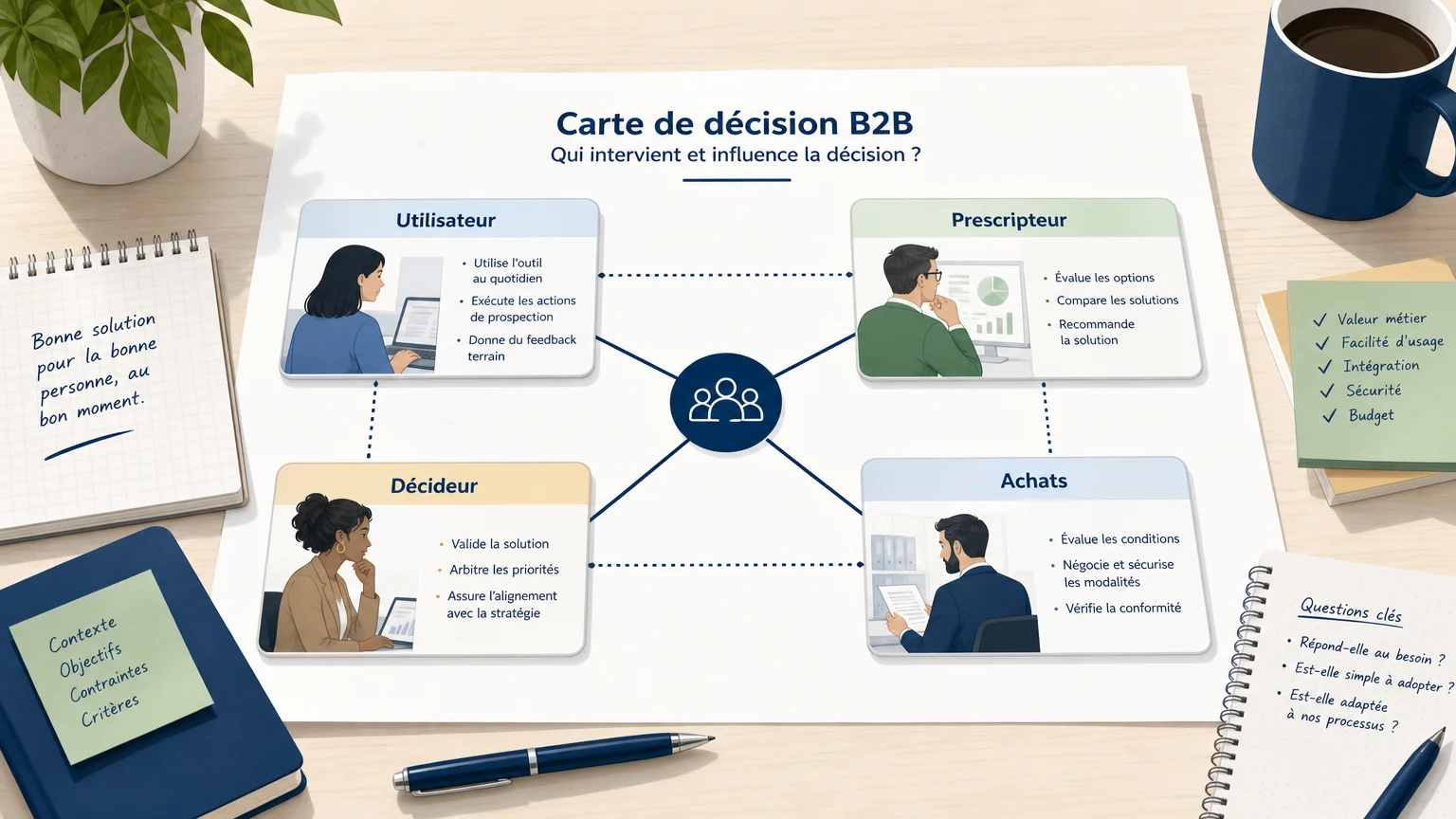
To avoid speaking to the wrong person, map the decision committee. Start by identifying the problem and the relevant department, then look for roles that might use the solution, recommend it, or fund it. To delve deeper into this step, we have also prepared a resource on how to identify key decision-makers.
The channel then depends on the profile and context:
- Email to briefly present a hypothesis and propose a resource or a specific question.
- LinkedIn to contextualize initial contact, observe posts, and gradually build a relationship.
- Phone when real-time qualification is important and contact details are reliable.
- Event or referral when trust and direct conversation play a central role.
Multichannel prospecting doesn't mean repeating the same message everywhere. Each channel should have a function. An email can introduce the topic, LinkedIn can provide context, and a call can verify interest or priority. If the prospect responds, stop the automated sequence and resume the conversation humanly.
Qualify with simple questions and useful scoring
Qualification should not resemble an interrogation. It should allow you to understand the prospect's situation and decide on the most relevant next step: continue, nurture the relationship, hand over to a salesperson, or remove the contact from the process.
You can structure your exchanges around four themes similar to the BANT method, without reciting the acronym:
- Need: what problem are you trying to solve? What impact does it have today?
- Decision: who participates in the choice and validation of the project?
- Budget: what resources are planned or need to be allocated?
- Timeline: is there a deadline or an event that requires moving forward?
Questions should remain adapted to the context. Instead of directly asking "are you a decision-maker?", ask who needs to be involved for a project to move forward. Instead of demanding a purchase date, seek to understand what would make the topic a priority in the coming months.
A simple lead scoring can then help you prioritize. Assign points to criteria that truly predict the quality of an opportunity, then subtract points when the prospect doesn't match the target, has no clear need, or shows no immediate action horizon.
Don't give too much weight to weak signals. An email open or a page visit indicates an interaction, not necessarily a buying intent. Conversely, a demo request, a specific question, a communicated deadline, or the involvement of a decision-maker are more useful elements for determining the next action.
Organize follow-up without losing context
A qualified lead might become a priority, then be put on hold, before becoming relevant again a few months later. Without a reliable history, the team risks repeating a message, forgetting a follow-up, or losing information collected during an exchange.
Your process must therefore at minimum retain:
- the lead source;
- the criteria justifying its inclusion in the target;
- the identified problem or need;
- the people involved in the decision;
- the last interaction;
- the planned next action;
- the reason for putting on hold or disqualification.
A lead management software can centralize this information and make follow-ups more consistent. The tool doesn't replace sales judgment, but it helps visualize priorities, share context, and measure transitions between contact, qualified lead, and opportunity.
For a small team, a structured spreadsheet might suffice initially. When channels multiply, when several people work on the same accounts, or when follow-ups become difficult to track, a specialized tool becomes more relevant. We can then use lead management software to maintain a common view of sales tracking.
The metrics to track should remain tied to decisions. For example, measure the percentage of leads genuinely matching the ICP, the qualified response rate, the number of meetings converted into opportunities, and the average time between initial contact and the next step. The number of messages sent alone doesn't indicate if your targeting is working.
Comply with prospecting rules in 2026
An effective sales approach must also be defensible. The collection, enrichment, and use of personal data must be linked to a clear, documented objective compatible with the chosen channel.
The CNIL reminds us of the rules applicable to prospecting via email, SMS, phone, and mail. For professionals, certain solicitations may rely on legitimate interest when the message relates to the person's activity, with appropriate information and a simple means to object.
In practice, always check the following points:
- the source and date of data collection;
- the professional relevance of the message sent;
- the identity of the contacting company;
- the ability to easily unsubscribe or object;
- limited data retention;
- the deletion of contacts who no longer wish to be solicited.
Regulations do not turn qualification into an administrative formality. On the contrary, they reinforce the importance of precise targeting. The more your message is linked to the recipient's professional role and a truly relevant problem, the less you need to multiply solicitations.
Key takeaways for finding better prospects
The most reliable method involves starting with your best customers, formalizing an actionable ideal customer profile, searching for accounts that show both a good fit and a timing signal, then verifying the right contact person before any outreach. Qualification then continues within the conversation, with simple questions about needs, decision-making, budget, and timeline. In 2026, finding qualified prospects means focusing less on volume and more on building a precise, documented process that can evolve based on real results.
Structure your prospect search
When searching, enrichment, drafting, and follow-ups are spread across multiple tools, qualification becomes difficult to maintain. We can centralize these steps within a single prospecting logic, while still maintaining human validation before executing prepared actions.
Our solution analyzes your offer, deduces an ideal customer profile, searches for prospects, and suggests actions on LinkedIn, via email, or by phone. The trial allows you to unlock 500 credits without a credit card after configuring and validating your first campaign. Credits are then billed per usage, starting from €80 ex VAT for 1,000 credits, with adjustable or terminable volume without commitment. Try our sales prospecting software.
Frequently asked questions
What is the difference between a contact and a qualified prospect?
A contact is an identified person or company. A qualified prospect matches your target, has a relevant need, and offers a realistic possibility for exchange or purchase.
What criteria should be used to qualify a B2B prospect?
The main criteria are alignment with your ICP, need, purchasing power, decision-making authority, and the anticipated timeline. Data quality and channel relevance should also be verified.
Should you contact the decision-maker directly?
Not always. The user, influencer, and decision-maker can play different roles in the decision. The goal is to understand the buying committee and involve the right people at the right time.
What is the best channel for finding qualified prospects?
There is no universally suitable channel. The choice depends on your target, their behavior, the complexity of the offer, and the level of trust required, hence the value of a consistent multichannel approach.
How can AI help qualify prospects?
It can accelerate sourcing, enrichment, context analysis, and message preparation. With our prospecting agent, prepared actions remain subject to user validation, who retains the commercial relationship and the final decision.