
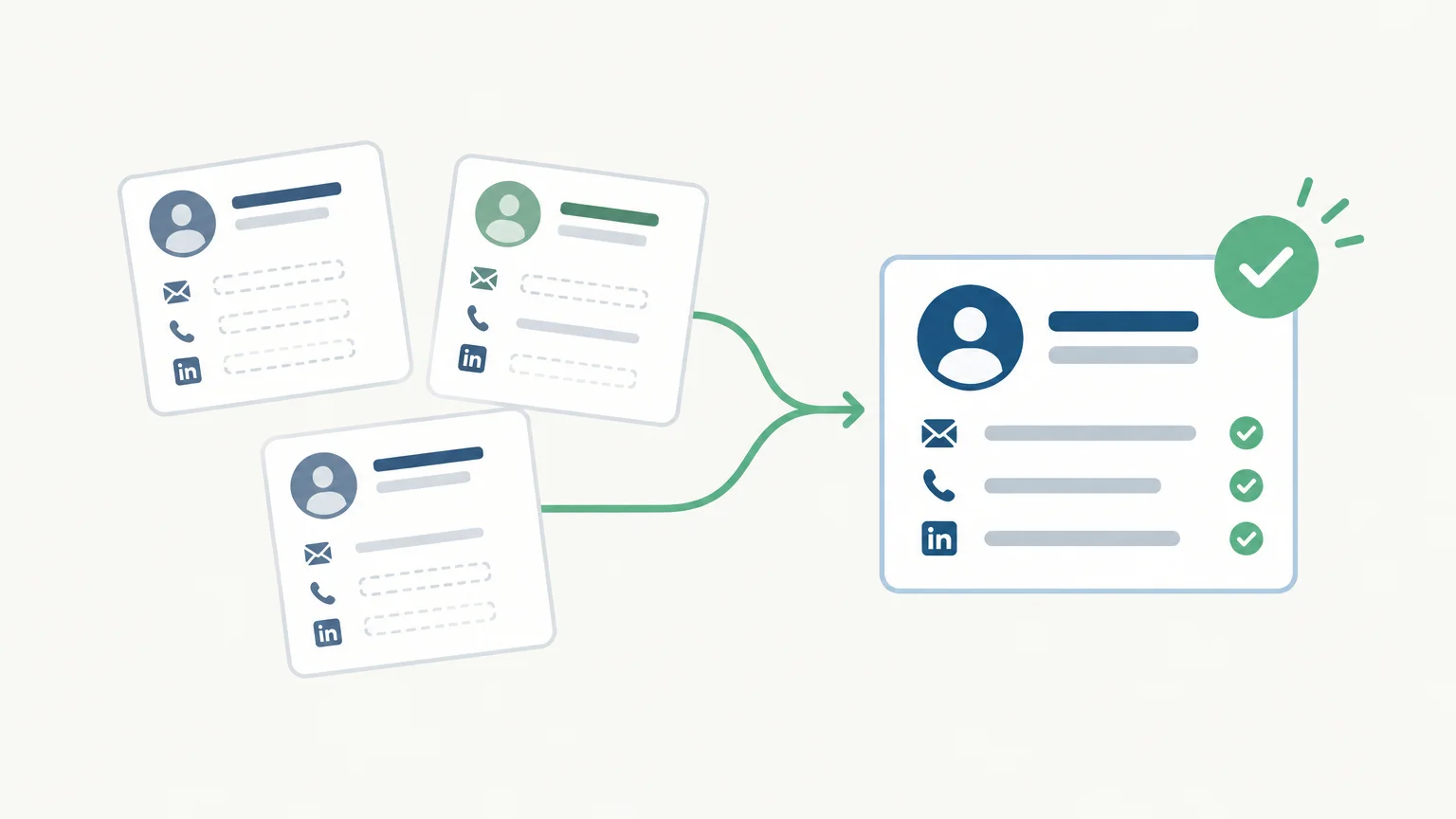
What good is a prospect list if contact details are missing, job titles are outdated or several rows refer to the same company? Prospect list enrichment involves adding or updating information to help you target and reach the right people. To save time at this stage, our prospect enrichment tool fits into your B2B prospecting workflow.
Enrichment does not mean adding as many fields as possible. It works best when each data point supports a specific decision, such as checking whether a company fits your target profile or finding the right business channel to reach someone. The goal is a more reliable, usable database—not to confuse available data with genuinely useful information.
What does prospect list enrichment mean?
Enrichment involves adding missing information, updating existing fields or linking a record to a more clearly identified entity. In a B2B list, this may relate to a company, one of its locations or the person you want to contact. For example, a record containing a company name and a first name could be supplemented with a company identifier, industry, job title or verified email address.
This process differs from two tasks often carried out alongside it. Data cleaning corrects formatting and flags duplicates or inconsistent values. Sales qualification assesses whether a company or contact meets your targeting criteria. Adding an address enriches a record, but it does not prove that all its other information is accurate or that the prospect is interested in your offering.
A list can therefore be enriched without being properly cleaned, or clean without being sufficiently qualified to guide a campaign. Defining these goals separately helps you measure the work completed: fields filled in, records corrected, duplicates identified and prospects deemed relevant.
Which data should you add to a B2B list?
Imagine a company list containing only names and websites. Depending on your needs, useful information may relate to the company, the contact or how to reach them.
- Company data: legal identifier, business activity, industry, address, size or registration status, where needed for targeting.
- Contact data: name, job title, department, business email address or business phone number.
- Prospecting information: available channel, verification date, data source or context that helps personalize your outreach.
For a French company, an official identifier can help distinguish businesses with similar names. The Sirene API documentation, published on September 30, 2026, distinguishes legal entities identified by a SIREN number from establishments identified by a SIRET number. It also supports searches for current and historical data. These identifiers make it easier to match company information, but do not, on their own, provide contact details for the people who work there.
The right choice depends on how you will use the data. If you want to segment your market, prioritize consistent company-level criteria. If your goal is to reach a person, first verify their role and business contact details. Adding attributes without knowing how they will be used makes your list more complex without necessarily improving sales decisions.
How do you choose sources and verify record matches?

Before adding a field, ask where the data comes from, when it was verified and how it will be matched to the correct record. Data from an official register may be suitable for identifying a legal entity, while business contact details or job titles require a source suited to that information. The source should also specify its terms of use and, where possible, the collection or verification date.
The CNIL's June 2024 recommendations note that reusing personal data published online for prospecting requires, among other things, informing the people concerned and enabling them to exercise their rights. The fact that information is publicly accessible is therefore not enough, on its own, to determine how it may be reused.
Record matching is a task in its own right. A stable identifier, such as a company registration number or business email address, is generally more useful than a name alone. A trading name may refer to several entities, and a single group may include several establishments. When a match is uncertain, it is better to flag the record for review than automatically merge data that may not relate to the same organization.
Test a sample before processing the entire list. Check a few records manually, identify missing values and compare results across sources. Keep the original value, the added data, its source and its verification date. This source traceability makes future checks easier and helps explain why two pieces of information conflict.
What process keeps your list usable?
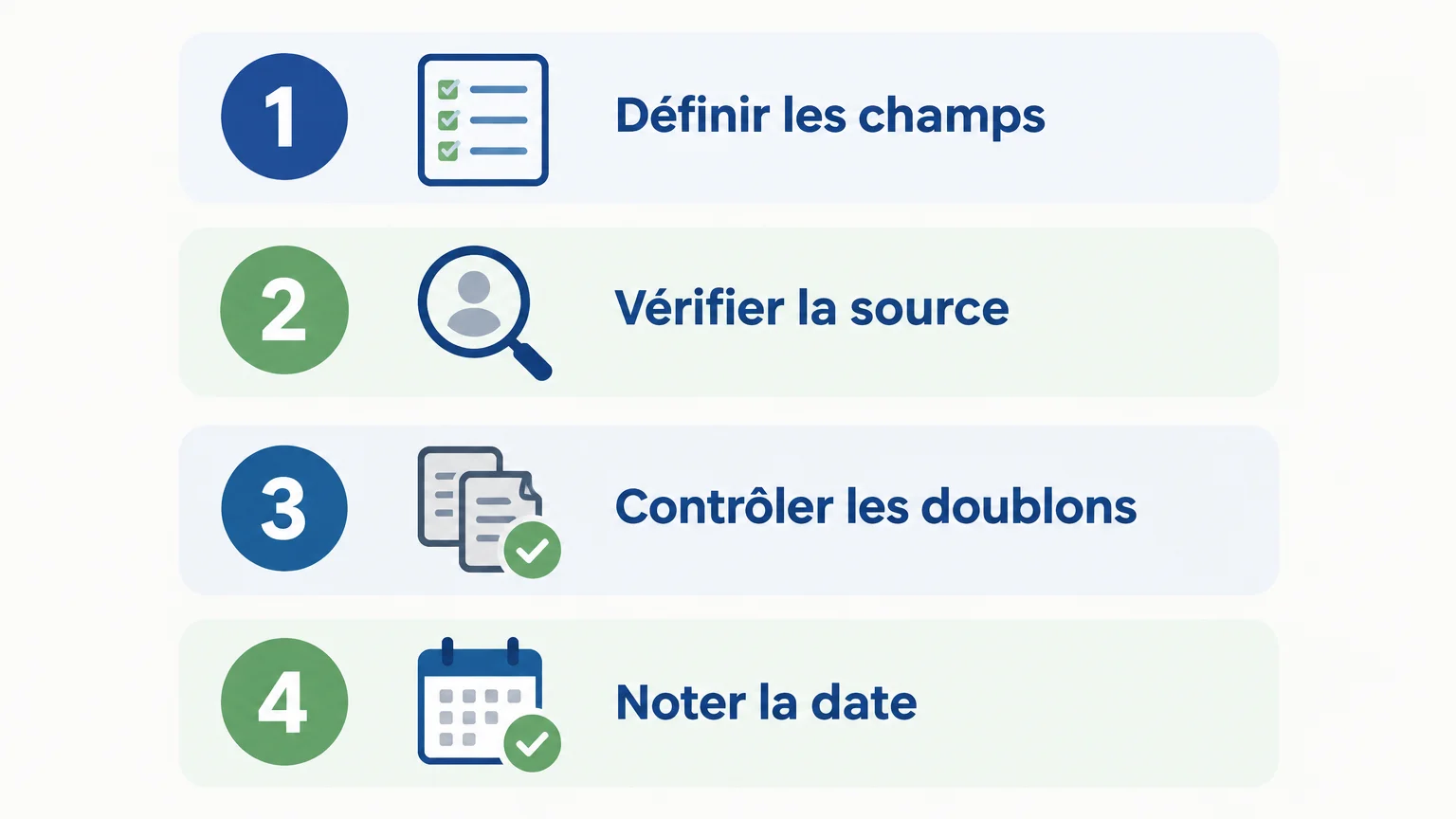
A list of 500 contacts does not need to start with bulk processing. Work in stages, keeping an original copy so you can review the changes.
- Define the purpose: specify which decisions the list should support and select only the necessary fields.
- Identify gaps: count missing, inconsistent or potentially outdated values, then prioritize the fields.
- Choose your sources: check their provenance, update dates and terms of reuse.
- Match and verify: use suitable identifiers, review ambiguous cases and handle duplicates before merging.
- Document the results: retain the old value, the new value, its source and its verification date.
After enrichment, establish a maintenance routine. For example, deduplicate new records with each import and log corrections made by the team. Review frequency depends on the fields and how they are used: a job title may change, whereas a company's legal identifier follows a different pattern. A verification date helps you focus on information that needs another check, rather than reprocessing the entire list indiscriminately.
This approach fits naturally into prospect sourcing and enrichment: finding contacts, adding contact details and managing sales follow-up can all be organized within a single workflow. If you do not have a list to start with, see our resource on free prospect lists, then verify the data before using it.
Which rules apply to personal data?
A named business email address or a job title linked to an identifiable person counts as personal data. You must therefore define a purpose, limit the information to what you actually need and put processes in place to respect individuals' rights. Applicable obligations depend in particular on the data processed and the outreach channel used; do not assume that data can be used for any campaign simply because you found it online.
The official GDPR text, adopted on April 27, 2016, requires, among other things, that data be accurate, kept up to date where necessary, relevant and limited to what is necessary for its purpose. In practice, this means avoiding fields collected “just in case,” correcting inaccurate information and establishing a process for handling objections.
Also document where the data came from, its purpose and the retention rules. If a provider enriches the list on your behalf, review the information it supplies about the sources used, each party's responsibilities and how requests from the people concerned are handled. For a specific case, have your approach reviewed by the person responsible for data protection or a qualified adviser.
Keep the data that truly matters
Useful B2B data enrichment starts with a simple question: what decision should this data point help you make? Choose targeted fields, match records using relevant identifiers, check results on a sample and keep a record of sources and dates. A well-maintained list is easier to use, correct and develop in line with applicable rules.
Make enrichment part of your prospecting workflow
When prospect research, contact verification and follow-up are scattered across different processes, teams lose track of useful information. At GetCalls, we integrate sourcing and contact enrichment into the prospecting workflow, then present AI-prepared actions for approval before they are carried out.
Our agent analyzes more than 50 data sources, without guaranteeing that every source or contact detail will be available for every prospect. As of October 23, 2026, 1,000 credits cost €80 excluding VAT. An email record with an enriched, verified address uses 3 credits, a phone record with an enriched number uses 9, and no credits are charged if enrichment fails. Explore our sales prospecting software to bring these steps together in one workflow.
Frequently asked questions
What does data enrichment mean?
It means adding or updating fields in a dataset using suitable sources. For a B2B list, this may relate to a company, a contact or their business contact details.
What is the difference between enrichment and cleaning?
Enrichment adds or updates information. Cleaning corrects formatting errors, identifies duplicates and improves the consistency of existing data.
Which data should you enrich first?
Start with the fields needed for your goal, such as the company identifier, industry, contact's role or a business contact detail. Leave out information you cannot verify or put to practical use.
Can you enrich a list with data available online?
Data available online is not automatically free to use for all prospecting purposes. Check the purpose, the rules applicable to the channel used, how individuals are informed and how their rights are respected.
Can one tool combine enrichment and prospecting?
Yes, some solutions integrate prospect research, contact enrichment and activity tracking. At GetCalls, our agent prepares actions based on the available data, while the team retains control of the sales relationship and the approval steps built into the process.