

A large industry is not necessarily fertile ground for sales. To choose an industry to target, start with the problem your offer solves and the companies you can actually reach. An effective lead sourcing strategy turns these choices into concrete criteria, rather than simply a list of business activities.
The number of companies in a market or its growth rate is not enough to assess its potential. You need to combine this data with how well your offer fits, evidence of demand, and access to decision-makers. To guide your research, resources from Bpifrance Création outline several types of sources to cross-reference, from official statistics to industry information.
Does your offer address a specific need in this industry?
Imagine you sell a tool that reduces the time spent handling customer requests. “Services” is too broad a target. A more useful segment might include service companies with a high volume of requests, a dedicated team, and a process that is still largely manual.
Describe each segment using the same elements: business activity, company size, location, relevant department, and problem to solve. Add the role likely to make or influence the purchase decision. This description forms your ideal customer profile, or ICP: it helps distinguish companies that could simply use your solution from those with a concrete reason to buy it.
Then validate this fit with existing customers or during sales conversations: what challenge prompted their search, what cost or impact did the problem have, and how did they choose a solution? Their answers help you refine the segment rather than infer a need from an industry classification code alone.
How much of the market can you actually reach?
An industry with many companies may look promising, but only some will match your criteria and be within your team’s reach. Assess your reachable market: relevant companies in the areas you cover, with identifiable contacts and a suitable way to reach them.

Official data helps estimate the size and structure of a market, not prove that every company is a potential customer. In France, the non-agricultural, non-financial business sectors included 5.2 million enterprises in 2023, within the scope covered by Insee figures published in January 2026. This total provides a broad overview; it does not replace a count of companies that fit your offer.
Refine your estimate by grouping companies by size or region, for example. Then weigh that volume against your resources: how many decision-makers can you identify and contact, and how many qualified opportunities can your team handle? A smaller, well-defined prospect list is more actionable than an overly broad theoretical market.
Once you have defined the segment, our approach can help turn it into search criteria: our agent analyzes a website URL, a catalog, or an offer description to infer an ideal customer profile. This structures your targeting without claiming that one industry is better than another. To move from defining your target audience to qualifying prospects, explore our method for finding qualified leads.
What signals indicate a current need?
A company that is hiring, opening a new location, or announcing an investment offers clues about its activity. But these events alone do not prove it will buy your solution. Focus on signals directly linked to the problem you solve, then verify them for each target company.
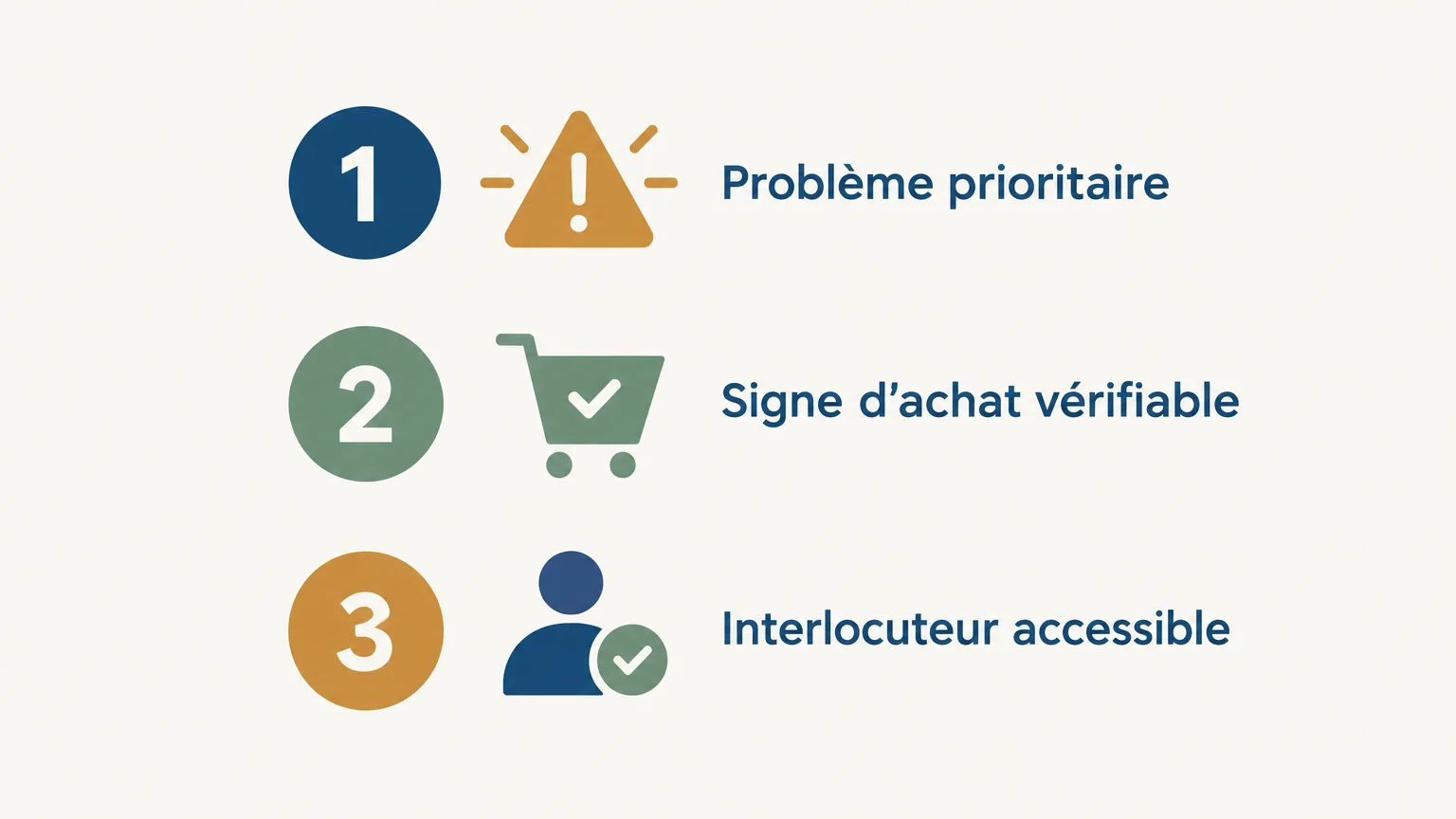
Relevant signals depend on your offer: hiring for a specific function may matter to a recruitment service; a regulatory change may create a need for advisory support; expansion may make a tool for managing higher activity levels more useful. The question is simple: what observable event makes your solution more necessary right now?
Public data can complement this monitoring. In France, France Travail’s 2026 workforce needs survey presents hiring plans by industry and local employment area, based on nearly 416,000 responses analyzed. This data sheds light on recruitment needs, not intentions to buy a product or service; use it as context, not direct evidence of demand for your offer.
For each segment, record the signal observed, its date, its source, and its connection to your value proposition. You can then distinguish a targeting hypothesis from verified evidence and avoid contacting a company based on a general trend that does not apply to it.
How do you compare competition, value, and sales cycles?
Two industries may have similar needs but require very different sales efforts. In one, several suppliers already address the problem; in another, your solution is less familiar, but the buying process is lengthy and involves multiple people. Compare each option by contract value, time to close, solutions already in place, and your ability to stand out.
Competition is not just about the number of suppliers. Examine the solutions companies already use, including internal processes or simply maintaining the status quo. Note the specific reason that might prompt them to consider an alternative. If your differentiation is still hard to explain in one sentence, the segment may call for more precise positioning.
Give each criterion a simple rating, such as low to high, then compare industries without changing your method along the way. You can assign more weight to criteria that matter most to your business model, such as contract value or ease of access to decision-makers. The goal is not to produce a universal score, but to make the strengths and weaknesses of your choice clear.
How do you validate an industry before focusing your efforts?
Before committing the whole team, choose two or three comparable segments and run a pilot campaign for each. Keep the offer the same and your outreach approach consistent; otherwise, you will not know whether differences in results come from the industry, the message, or the channel.
Track each stage of the journey: available contact details, relevant replies, qualified conversations, meetings, opportunities, and sales. Also record objections and the time needed to secure a meaningful conversation. Successful prospecting is about more than reply volume: check whether contacts have the need you are targeting and whether the sales effort remains sustainable.
If you target several French-speaking countries, repeat this validation locally. Industry structures, market sizes, and available sources vary from country to country. For the European Union, the 2026 edition of Eurostat’s business statistics lets you compare countries and examine indicators by sector. Market data guides your analysis; testing with prospects confirms whether your proposition genuinely interests them.
A pilot campaign also helps refine your list criteria: company size, roles to contact, territory, and signals to monitor. To structure this step, our resource on lead sourcing and enrichment explains how to connect company research with contact qualification.
Choose an industry using verifiable criteria
The right choice rests on a practical combination: fit with your offer, reachable companies, signals of need, and sales potential that aligns with your sales cycle. Compare segments using the same framework, verify the data for your target country, then test your hypothesis with prospects before scaling your efforts. The industry to prospect in is the one whose results provide the strongest evidence of that fit.
Turn your target audience into actionable outreach
Once you have chosen an industry, the next step is to find companies that fit your offer, identify the right contacts, and prepare a relevant approach. Our prospecting agent helps organize this work using your website, catalog, or offer description.
Prepared actions are presented for approval, while LinkedIn, email, and phone are brought together in a single inbox. You own the customer relationship and stay in control of what gets sent. Try our sales prospecting software for free, with no credit card required; 500 credits are unlocked after you set up your account with LinkedIn or email and approve your first campaign.
Frequently asked questions
How do you choose an industry to target?
Start with the problem your offer solves, then define the relevant companies by business activity, size, location, and the people you need to reach. Next, check how many companies are within reach and test your hypothesis with prospects.
Is a large market always more attractive?
No. Overall volume does not tell you how much of the market matches your ideal customer or how many companies your team can reach. Compare the reachable market and the effort needed to generate qualified conversations.
Which B2B buying signals should you monitor?
Look for events linked to the problem your offer addresses, such as expansion or organizational change. Verify each signal at the company level and do not confuse it with confirmed purchase intent.
Should you prospect in several industries at once?
Comparing two or three segments in a pilot test can reveal which responds best to your offer. To interpret the results, keep your criteria and approach comparable across segments.
Can a tool help you select an industry?
A tool can help turn a defined target audience into search criteria and organize sourcing, but your choice of industry depends on your offer and what you learn from sales activity. Our GetCalls agent analyzes an offer description to infer an ideal customer profile and prepare your outreach.