
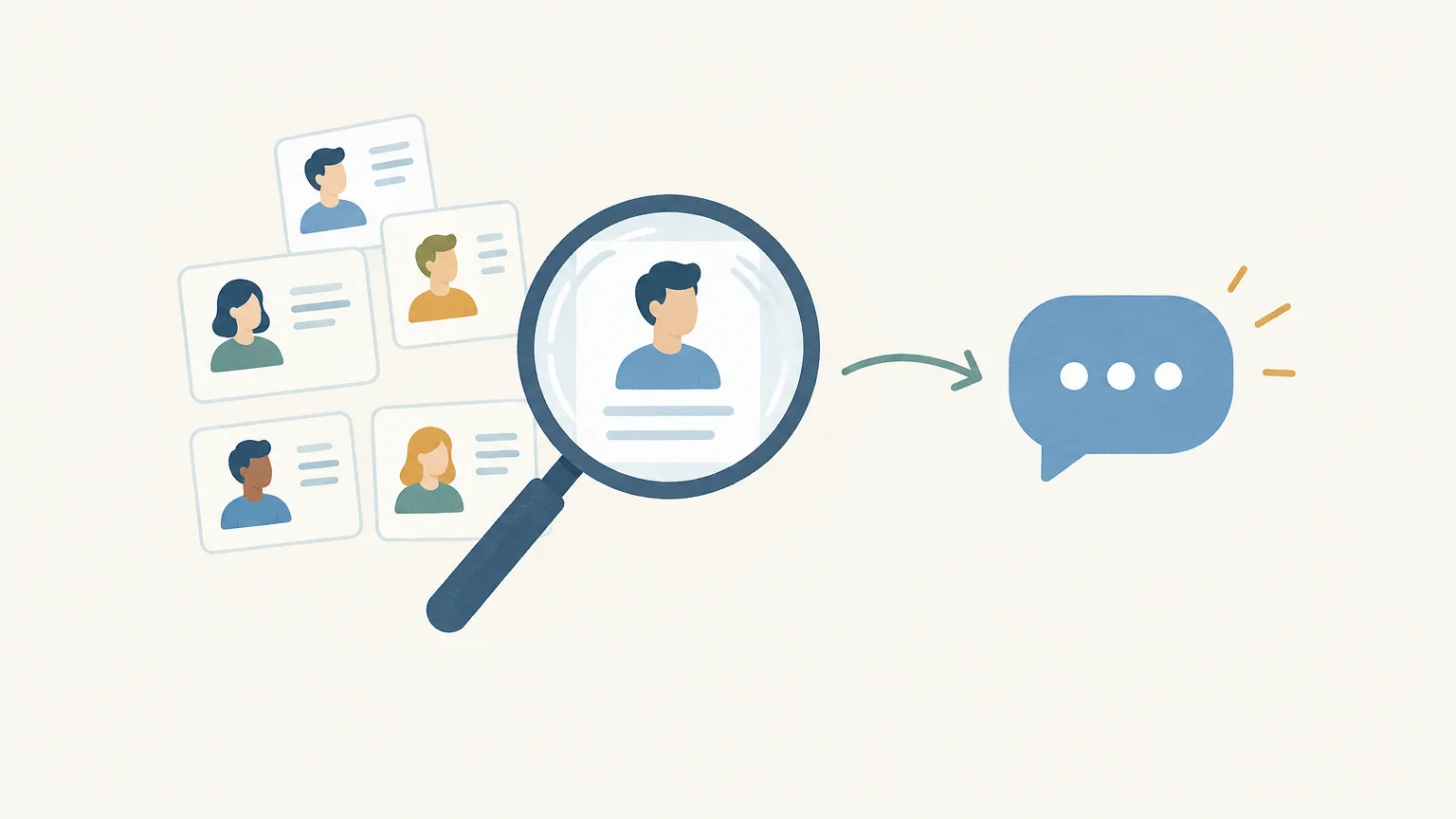
An accepted connection request is not enough to create an opportunity. To prospect effectively on LinkedIn, start by targeting the right people and giving them a concrete reason to talk. If you want a more structured approach to choosing your tools, LinkedIn prospecting tools can support certain steps, but they cannot replace relevant targeting or a thoughtful approach.
In B2B, a profile view, a connection request, or a message marks the beginning of a conversation, not an end in itself. An effective approach connects targeting, the prospect’s context, outreach, and follow-up. It also adapts to how familiar you already are with each other: a cold contact should not be approached in the same way as someone who has engaged with a post or accepted a connection request.
1. Define a target audience you can actually identify
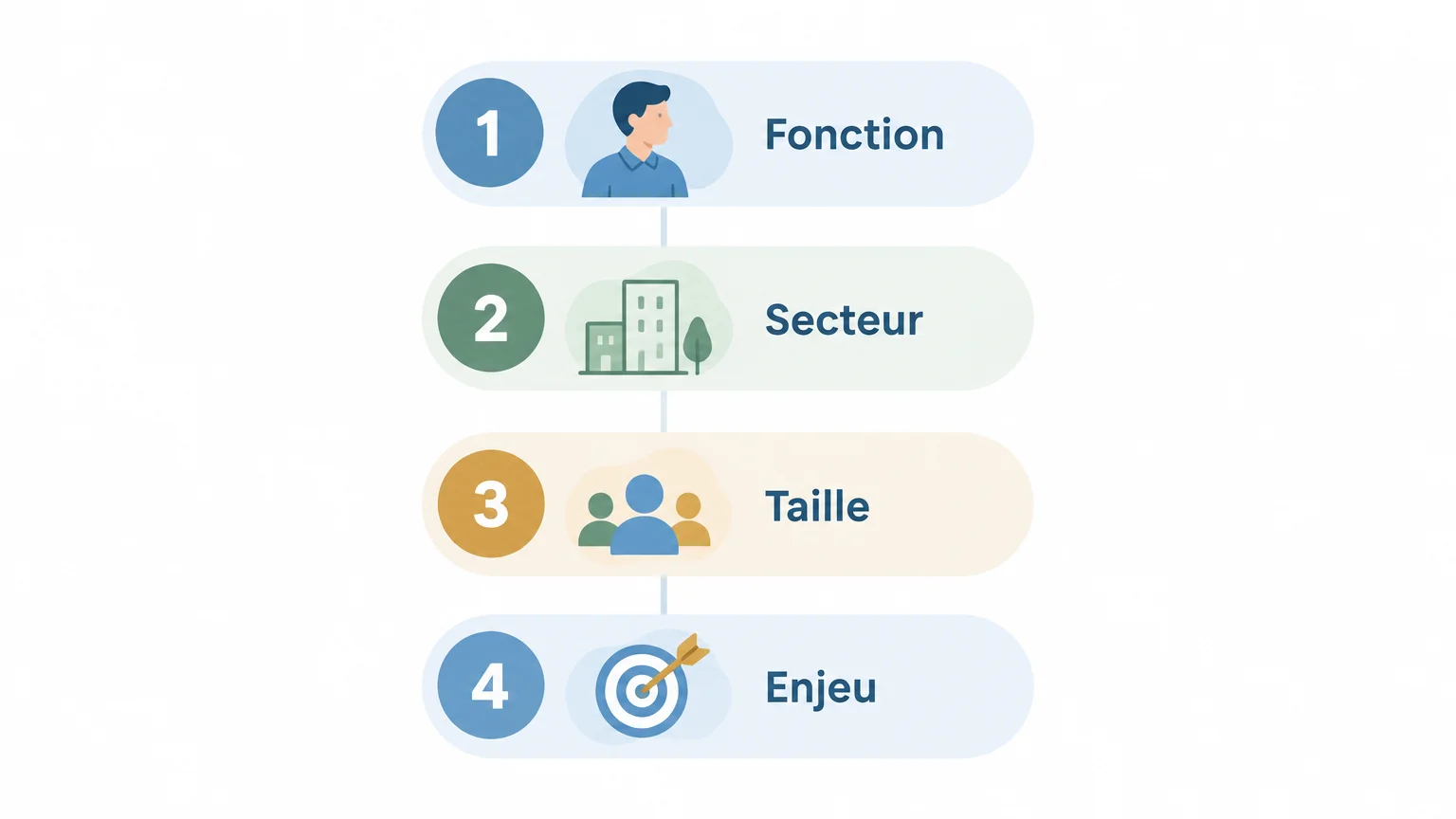
Who are you trying to reach, and why would your offering be relevant to them? Answer these questions before opening LinkedIn search. An actionable target audience combines observable criteria: role, industry, company type or size, location, and a business challenge your solution addresses.
For example, “business leaders” is too broad. “Sales managers at small and midsize service companies building a sales team” already gives you a way to filter profiles and choose a conversation angle. If your offering serves several functions within the same company, identify the relevant stakeholders rather than focusing on a single decision-maker. A LinkedIn report published in 2025 states that the average B2B sales cycle involves more than 11 decision-makers. This LinkedIn finding makes the case for mapping the buying group rather than assuming one contact is enough.
Next, create a small, focused list and check each profile before adding it to your sequence. Confirm that the person still holds the role you are targeting and that their company meets your criteria. This check prevents you from personalizing a message based on outdated information or a job title alone.
2. Build a profile that reinforces your relevance
Imagine a prospect opening your profile after receiving your connection request. Within seconds, they should understand your role, who you help, and the business problem you help solve. A clear headline and a specific About section make this easier than a string of internal job titles or vague statements.
Present your value proposition in language your audience uses. Explain who you work with, which challenge you address, and what visitors will find on your profile. A post, an example of your approach, or an industry analysis can strengthen that impression, provided it is directly useful to your audience.
Your profile should not read like an aggressive sales page. It provides context and shows that your message aligns with your expertise: if your outreach mentions a challenge that never appears on your profile, the prospect has to connect the dots themselves.
3. Start with genuine context, not a pretext

The reason for reaching out often makes all the difference. Having a role similar to another prospect’s is not, on its own, a reason to send a message. Instead, look for something public and relevant: a recent post, a new role, a project they have mentioned, or a challenge facing their industry.
Useful context helps you ask a specific question without claiming to know what the person needs. For example: “Your post about hiring sales reps raises an interesting question: how do you qualify inbound inquiries?” This opening stays grounded in something observable and lets the prospect decide whether to continue the conversation.
If you cannot find a genuine reason to reach out, do not manufacture familiarity. You can choose a broader business angle, but simply explain why their profile fits the audience you work with. For a deeper look at the overall approach, visit our page on LinkedIn prospecting methods.
4. Write a first message that invites a reply
A good first message is brief, easy to read, and focused on the recipient. It explains why you are reaching out, connects that context to their work, and ends with an easy-to-answer question. Avoid lengthy sales pitches, detailed company introductions, and meeting requests before you have started a conversation.
You can use this structure: “Hi [First name], I saw your post about [specific topic]. Your point about [concrete detail] caught my attention, as we often see this issue at [type of company]. How are you approaching it today?” Replace every bracketed element with an accurate observation. If you cannot do that without inventing something, choose another angle.
Once the conversation starts, listen to the response before presenting your offering. Reflect back the problem they describe, check your understanding, then suggest a resource or a call if it genuinely helps address the issue. To refine your wording, you can also explore our tips for writing effective sales messages.
After someone accepts your connection request, avoid automatically sending the same sales pitch to everyone. A thank-you followed by a question relevant to their profile is often a more natural opening. If they reply, adapt your next steps to what they say rather than running through a predefined sequence that ignores the conversation.
5. Organize follow-ups and measure what works
A campaign becomes easier to improve when you track each stage separately. Record the target segment, the context you used, the message you sent, and what happened next. Distinguish between accepted connection requests, replies, qualified conversations, and booked meetings: these metrics measure different outcomes.
Benchmarks can provide reference points, not promises or universal targets. A compilation published in June 2026 by Overloop reports findings from several studies and highlights that acceptance and reply rates depend on factors such as industry, seniority, and outreach approach. Start by comparing your own segments and messages over a consistent period rather than judging a campaign by a single figure.
Plan a follow-up when it adds something new: an answer to a question, a relevant resource, or a useful clarification. If the prospect does not respond, space out your outreach and stop if they decline. If you continue prospecting to business contacts by email, the CNIL outlines their rights, including the right to opt out of electronic marketing.
When research, preparation, and follow-ups become repetitive, automation can reduce the execution workload. It should not choose your tone for you or ignore incoming replies. With our solution, AI-prepared actions are presented for approval before they are carried out; you can learn more about how to automate LinkedIn connection requests. Always check that your usage complies with the platform’s current terms.
For teams following up across multiple channels, a shared interaction history helps preserve context and avoid duplicate outreach. Our GetCalls agent brings LinkedIn, email, and phone together in one inbox, while sales reps stay in control of conversations and required approvals.
An effective approach starts with relevance
To prospect effectively on LinkedIn, start with a segment you can qualify, check the context of each profile, and write to open a conversation, not force a sales pitch. Organize follow-ups, respect refusals, and measure each stage separately. Tools and automation can reduce repetitive work, but the quality of your approach still depends on accurate targeting and how closely you pay attention to replies.
Bring structure to your LinkedIn prospecting
When finding profiles, preparing outreach, and following up become time-consuming, a shared workflow can simplify coordination without replacing sales conversations. We designed GetCalls to prepare prospecting actions on LinkedIn, by email, and by phone, then present them to the user for approval.
You can start a free trial with no credit card required. Once you have set up your account with LinkedIn or your email and approved your first campaign, 500 credits are unlocked. LinkedIn connection requests can be automated while keeping volumes under control. Explore our LinkedIn prospecting solution.
Frequently asked questions
How do you find relevant prospects on LinkedIn?
Define an ideal customer profile using observable criteria, such as role, industry, and company size. Then review each profile and find genuine context before reaching out.
What should you write in a LinkedIn connection request?
Briefly explain why you want to connect and refer to an accurate detail from the person’s profile or activity. Avoid turning the note into a sales pitch.
When should you follow up with a prospect on LinkedIn?
Follow up only if you can add something useful or revisit a specific point from the conversation. Space out your messages and stop if the person explicitly declines.
Should you automate LinkedIn prospecting?
Automation can help organize repetitive tasks, but it does not remove the need to check your targeting and context. With our GetCalls agent, prepared actions are presented for approval before they are carried out.
Which metrics should you track to evaluate your prospecting?
Track accepted connection requests, replies, qualified conversations, and booked meetings separately. Compare results by segment and approach to identify what needs adjusting.